
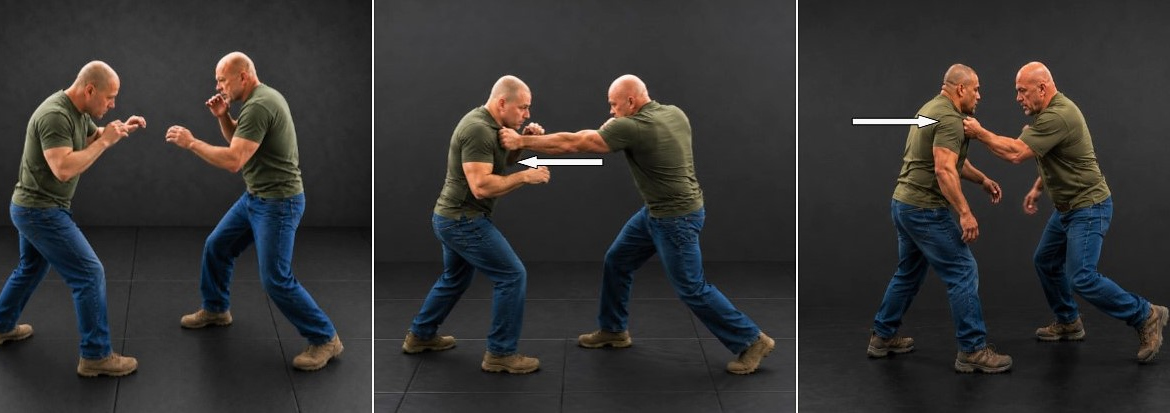
The False Lead Advantage
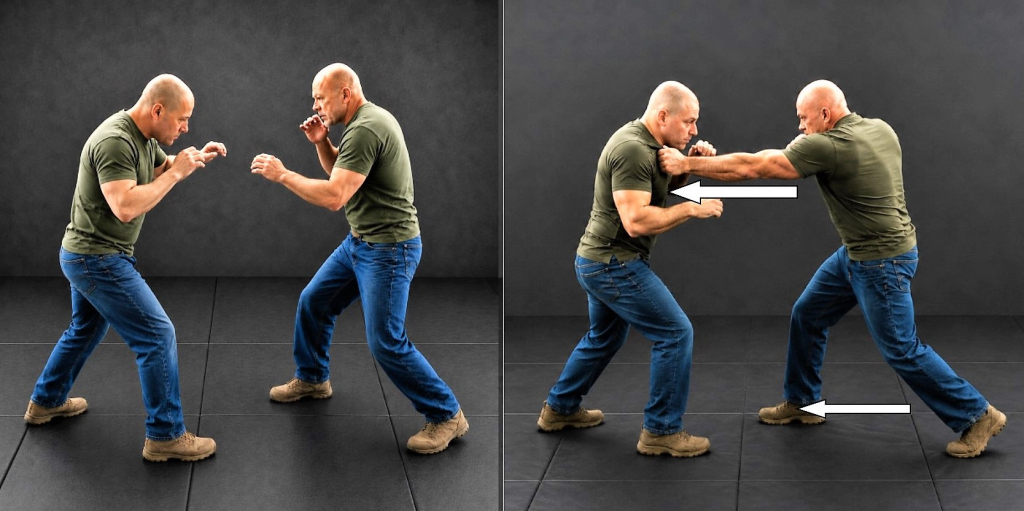 The False Lead is an asymmetrical, highly unorthodox combat posture that completely decouples the upper-body weapons from the lower-body base. By placing your right foot forward as your heavy anchor, yet blading your torso so your left shoulder and left hand command the frontline, you create a profound optical and mechanical paradox for your opponent. It is a stance designed specifically to dismantle traditional defensive blueprints, cut execution time in half, and weaponize an opponent’s own momentum against them.
- Structural Anatomy: Deconstructing the Blueprint
To understand why the False Lead is so formidable, we must first break down its structural geometry. Traditional grappling universally demands symmetry, matching a lead foot with a lead hand to maintain standard balance. The False Lead deliberately shatters this rule to create an asymmetric tactical trap.
The Lead Anchor (Right Foot Forward)
Unlike a conventional stance where the lead foot dictates the directional attack of the upper body, the right foot in the False Lead acts as a fixed, unmovable axle. It is planted firmly forward, biting into the mat and bearing your initial weight distribution. This anchors your position in the pocket while allowing your rear leg to remain completely dynamic, coiled for explosive directional changes or sudden depth adjustments.
The Frontline Shield (Left Shoulder Bladed)
By turning the torso nearly sideways relative to the opponent, you dramatically reduce your visible target area. Your left shoulder leads the frame, effectively hiding your hips and center of gravity from the opponent’s immediate reach. You are presenting a narrow, blade-like profile that is incredibly difficult to penetrate cleanly.
The Trailing Power Plant (Right Hip Retracted)
Because the left side is pushed forward, the right hip and right shoulder are heavily retracted in the rear. This orientation functions exactly like a boxer’s coiled rear hand; it stores massive potential kinetic energy, waiting to be unleashed through rotation.
- Utilization: The Kinetic Illusions of the Asymmetric Posture
A stance is only as good as its application. When you step onto the mats in the False Lead, you are forcing the opponent to play an unfamiliar game where their deeply ingrained, automatic reactions are rendered completely useless.
Stealing the Inseam (The Illusion of Distance)
Human spatial tracking relies heavily on looking at an opponent’s lead foot to judge safety. When an opponent looks at the False Lead, they spot your right foot forward and mentally calculate their distance based on that boundary.
However, because your upper body is severely bladed, your attacking left hand is pushed to the absolute front of your frame—physically six to ten inches closer to the opponent than their brain registers. You are effectively occupying their space before the exchange even starts, allowing you to snatch a dominant single grip while they believe they are still safely out of range.
The Cognitive Reaction Lag
Elite martial artists operate on pattern recognition. They know exactly how to counter standard right-handed or left-handed alignments. When they face the False Lead, the brain registers a right-foot-forward base (expecting right-handed mechanics) but encounters an aggressive, forward-reaching left hand.
This conflicting visual data creates an immediate micro-second of cognitive dissonance. The opponent’s brain hesitates while trying to solve the puzzle. In high-level combat, that split-second of hesitation is an eternity—it is the functional equivalent of a head start in a sprint.
Complete Hip Denial
Almost every high-amplitude throw requires an attacker to step deeply into the space between your hips. The False Lead builds a physical barrier against this entry. By pulling your left hip forward and retracting your right hip away from their centerline, you deny them a clean entry angle. If they try to force a traditional power throw, they are forced to reach blindly, stretching their posture and compromising their own balance.
Reverse Hip Throw from the False Lead
The Reverse Hip Throw is a powerful and aggressive technique designed to disrupt an opponent’s balance and execute a decisive throw by leveraging torque and momentum. By breaking the opponent’s balance and positioning their center of mass over your hip, you use your hip as a fulcrum—allowing leverage, rather than brute strength, to end a confrontation decisively even against a much larger opponent.
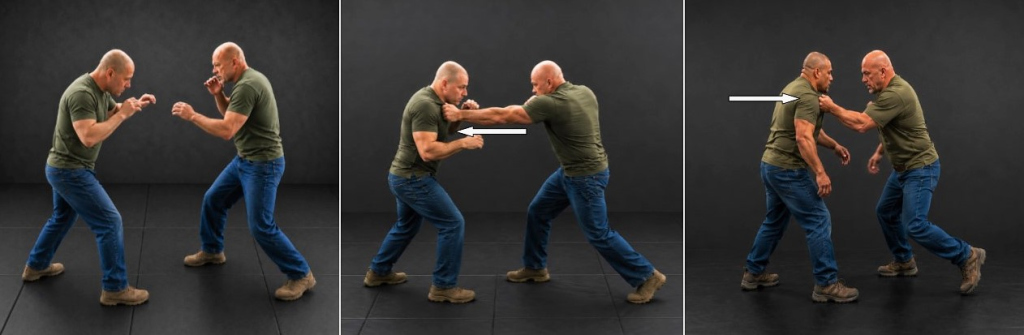
1.) From the false lead, 2.) push off the left foot and step straight in with the right foot at the same STRIKE your opponent hard on his right shoulder with the heel of your left hand and grab his clothing at the area struck. This is delivered much like a lead straight punch in boxing. The blow should be hard enough to cause him to momentarily lose balance. 3.) Pull the opponent toward you and bring your left elbow back in toward your hip. As you pull, push off your right foot and step toward eleven o’clock with your left foot to the outside of your opponent’s right foot.
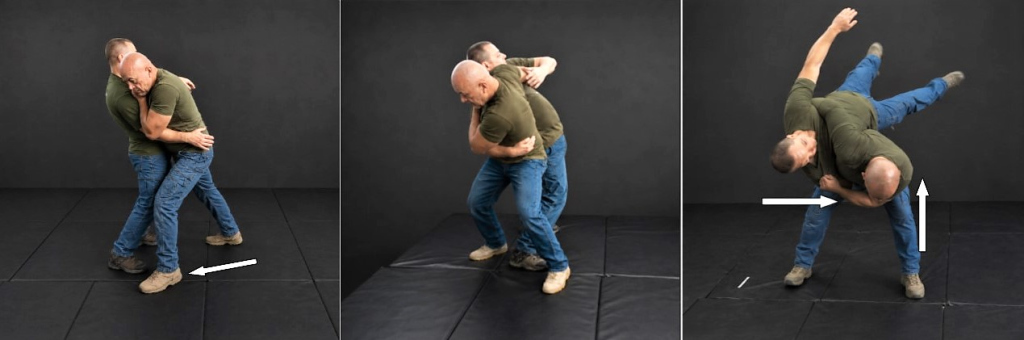
4.) Bring your right foot forward and Step around with your right foot, placing it directly behind the opponent. Thrust your hips to the right to achieve buttock-to-buttock contact, pulling the opponent onto your right hip. Their arm should be locked against your side by your left elbow. Your knees should be bent, your hips should be lower than his hips, feet shoulder width apart and your body bent forward slightly.
5.) Using your right hip as the fulcrum, straighten your legs thrusting your hips upward. Continue the pull with the left hand. At the same time bend forward and start turning your torso to the left.
6.) Finish the throw by the pulling your left elbow toward your left hip and knee forward and downward with both arms driving your opponent into the ground. Throw the opponent over your right hip and NOT over the outside of your right leg. Maintain your arm lock on the opponent’s right arm.
Reverse Hip Throw from the False Lead – Head and Arm Variation
1.) From the false lead, 2.) push off the left foot and step straight in with the right foot at the same STRIKE your opponent hard on his right shoulder with the heel of your left hand and grab his clothing at the area struck. This is delivered much like a lead straight punch in boxing. The blow should be hard enough to cause him to momentarily lose balance. 3.) Pull the opponent toward you and bring your left elbow back in toward your hip. As you pull, push off your right foot and step toward eleven o’clock with your left foot to the outside of your opponent’s right foot.
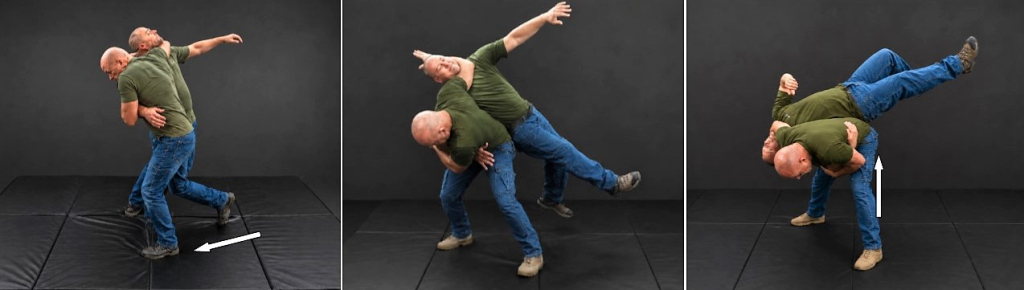 4.) Over hook and grasp your opponent’s right arm with your left hand at the triceps and pull his arm into you as your push of the right foot and step toward eleven o’clock with your left foot. STRIKE the throat or side of the neck with the inside (the boney area of your forearm) of your right forearm then encircle the opponent’s neck.
5.) Step your right foot directly behind the opponent. Your opponent’s right arm should be locked in to your side with your left elbow. Thrust your hips to the right to achieve buttock-to-buttock contact, pulling the opponent onto your right hip. Their arm should be locked against your side by your left elbow. Your knees should be bent, your hips should be lower than his hips, feet shoulder width apart and your body bent forward slightly.
6.) Using your right hip as the fulcrum, straighten your legs thrusting your hips upward. Continue the pull with the left hand. At the same time bend forward and start turning your torso to the left. Finish the throw by the pulling your left elbow toward your left hip and knee forward and downward with both arms driving your opponent into the ground.
JOIN THE UNITED STATES COMBAT JUDO FEDERATION TODAY! REAL COMBAT JUDO
For more information on Combat Judo and related subjects.
 THREE COMBAT JUDO EBOOKS — $12.99 EACH
From the battlefields of WWII to modern combative application, explore the history, biomechanics, tactics, and techniques of Combat Judo through three books by Barron Shepherd.
🥋 COMBAT JUDO: HISTORY AND TECHNIQUES
Discover the origins and evolution of U.S. Army wartime Combat Judo.
💥 THE CROSS HOCK TAKEDOWN
A definitive historical, biomechanical, and tactical study of one of the U.S. Army’s classic combat takedowns.
🥊 REAL COMBAT JUDO
No mats. No point scoring. Pure combative application.
💳 TO ORDER VIA PAYPAL:
Send payment to: winterhavenjudo@gmail.com Please include the title of the ebook you are purchasing and email address with your payment.
LEARN. TRAIN. APPLY. WIN.


