
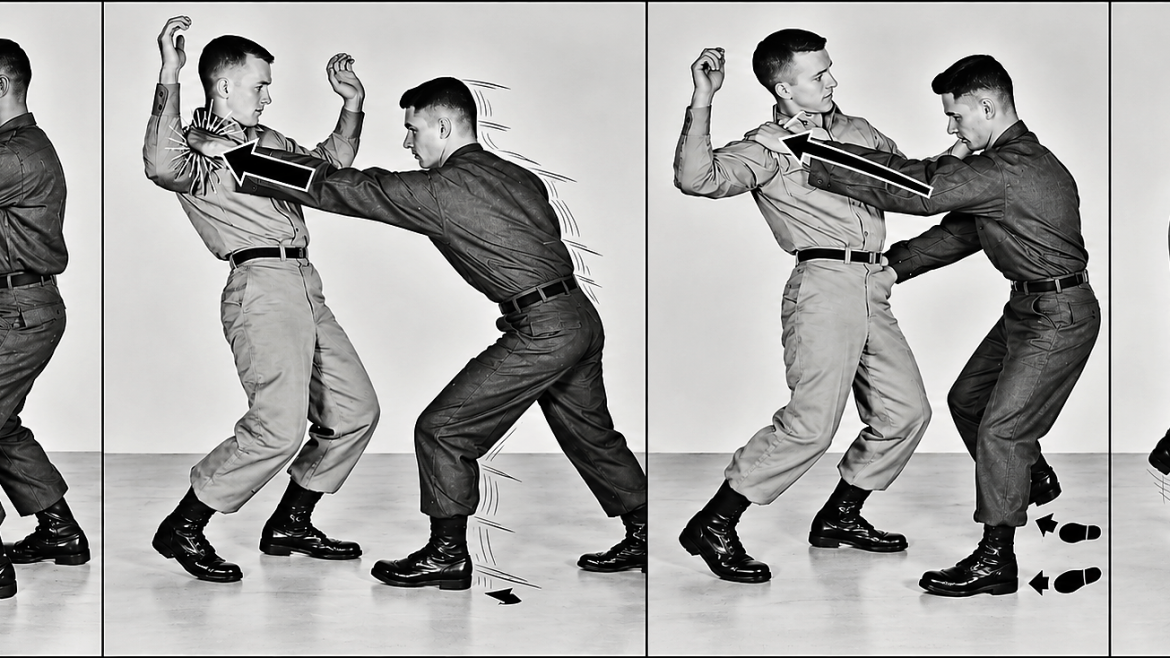
One of the most significant elements of the U.S. Army’s mid-century hand-to-hand combat doctrine was not simply the selection of Judo throws it taught, but how the soldier entered in to those throws. In the 1954 FM 21-150, Hand-to-Hand Combat, the Army incorporated a simple but tactically sophisticated method of entering several of its Judo-based takedowns: advance from the on-guard position while striking the opponent’s shoulder to disrupt his posture, then immediately continue into the throw.
Over time, this method largely disappeared from military manuals and from the way these techniques are commonly demonstrated. What was lost was more than a shoulder strike. It was an integrated method of combining footwork, impact, kuzushi, penetration, and throwing into one continuous action.
Beginning with the Army’s original linear and angular approaches, the concept can be developed through increasingly deceptive fighting positions: an unorthodox boxer’s stance, a more heavily bladed stance, and ultimately the false lead. The technique changes slightly at each stage, but the underlying principle remains constant: Disrupt the opponent’s posture while maintaining your own, and use that disruption to enter directly into the throw.
The Origin: The Army’s Shoulder-Strike Entry
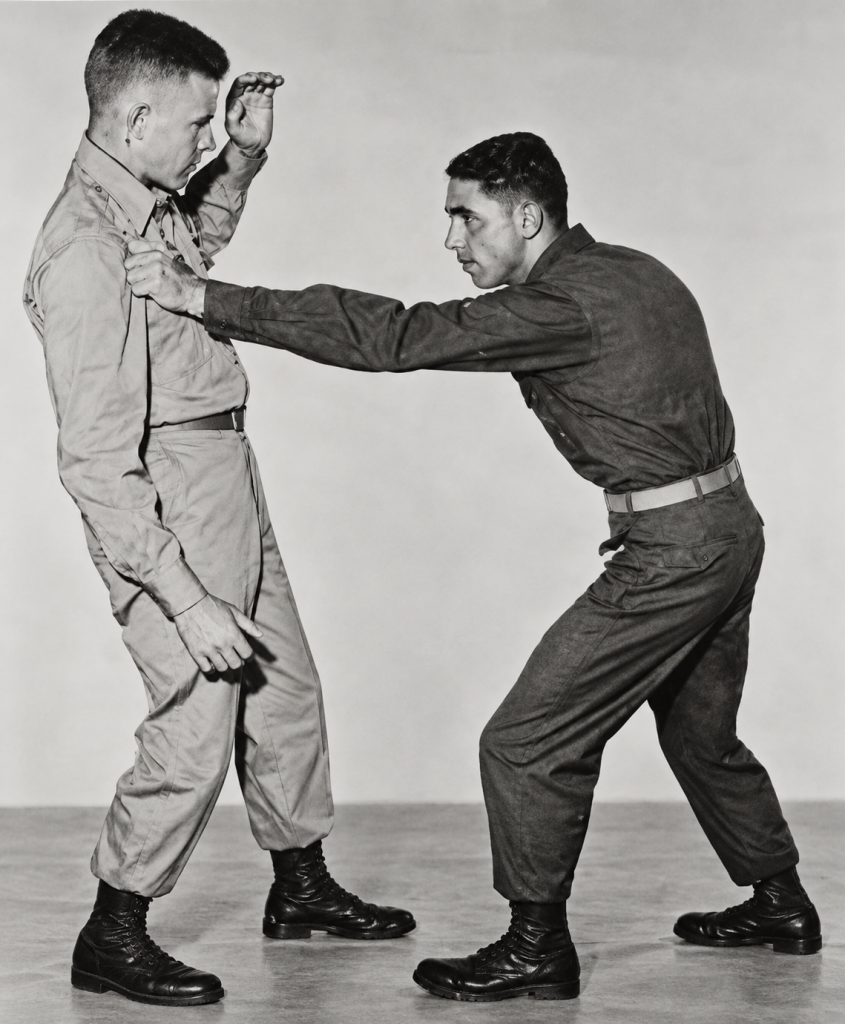
The historical method begins from an on-guard position resembling a boxer’s fighting stance. From that position, the defender steps forward with the left foot while simultaneously delivering a left open-hand strike to the front of the opponent’s right shoulder. The objective is not simply to hurt the opponent. The strike is intended to disrupt his posture at the exact moment the defender penetrates his space.
This is the critical point. The defender does not establish a position, stop, strike, stop again, and then begin his throw. The step and strike constitute the entry.
The defender maintains an athletic posture as he advances while the opponent’s upper body is displaced relative to his base. The defender is therefore attempting to compromise the opponent’s structural alignment without sacrificing his own.
The basic formula becomes:
STEP + STRIKE → POSTURAL DISRUPTION → CONTROL → THROW
This method was associated with Army applications of the Cross Hock Takedown, Hip Throw, and Shoulder Throw. Although the throws differ mechanically, the shoulder-strike entry provides them with a common tactical starting point.
Two Original Lines of Entry
The historical examples are particularly interesting because the shoulder strike is not demonstrated with only one line of movement. The Army shows both a linear entry and an angular entry, and the difference between them appears to be functional rather than merely stylistic. Each line of penetration places the defender’s body in a more appropriate position for the type of throw that follows.
One example has the defender stepping his left foot essentially straight forward toward the opponent’s right foot while simultaneously striking the front of the opponent’s right shoulder. This is the linear entry.
The defender penetrates directly into the opponent’s near side. The forward step carries bodyweight into the open-hand strike while the strike disrupts the opponent’s upper-body posture. Importantly, the defender does not initially need to rotate his body across the opponent. His movement remains predominantly forward.
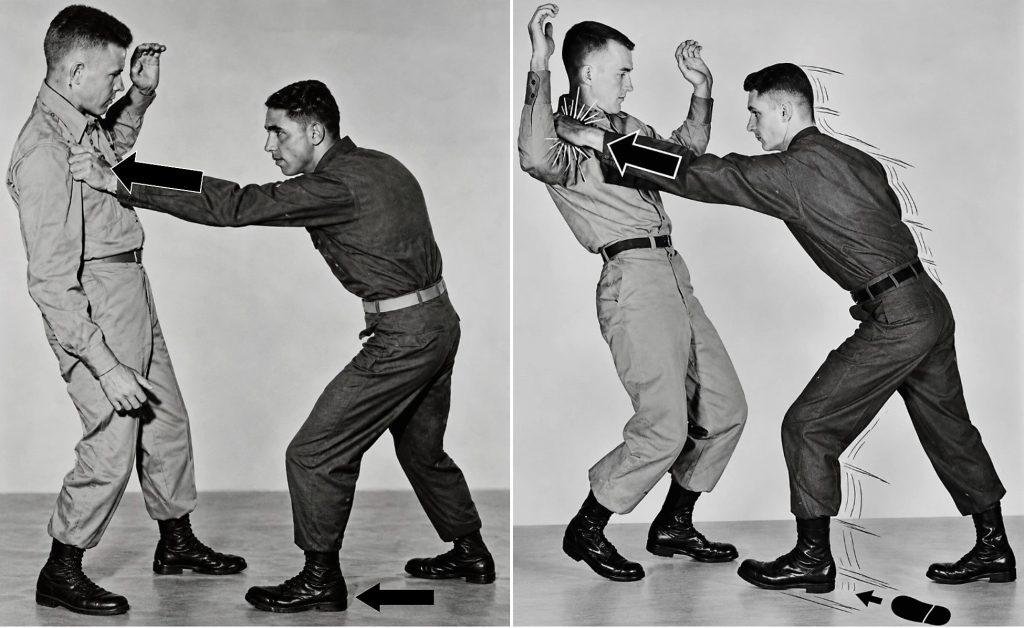
This linear entry is particularly suited to Army techniques such as the Cross Hock Takedown and Reverse Hip Throw, where the initial requirement is direct penetration rather than immediately turning the back or hip across the opponent.
In the Cross Hock Takedown, for example, the defender can penetrate directly with the shoulder strike, establish control and immediately convert the extraction of the striking hand into a powerful pulling action. The defender continues closing the distance while moving into position for the takedown. There is no need to make a large preliminary turn simply to establish the entry.
The Reverse Hip Throw similarly benefits from this direct penetration because the defender is moving into close body contact while maintaining a position from which the opponent can subsequently be thrown backward over or around the hip.
The linear entry can therefore be summarized as:
FORWARD STEP + SHOULDER STRIKE → DIRECT PENETRATION → CONTROL → TAKEDOWN
The second Army example changes the geometry considerably. Instead of stepping directly toward the opponent’s right foot, the defender steps the left foot diagonally toward the opponent’s left foot, while still striking the front of the opponent’s right shoulder.
This is the angular entry.
The hand continues attacking the same general area of the opponent’s upper body, but the defender’s center of mass is now traveling diagonally across the opponent’s position. This changes the defender’s relationship to the opponent’s base at the same instant that the shoulder strike disrupts the opponent’s posture. That makes the angular entry particularly useful for turning throws, including the Army’s Shoulder Throw and Hip Throw.
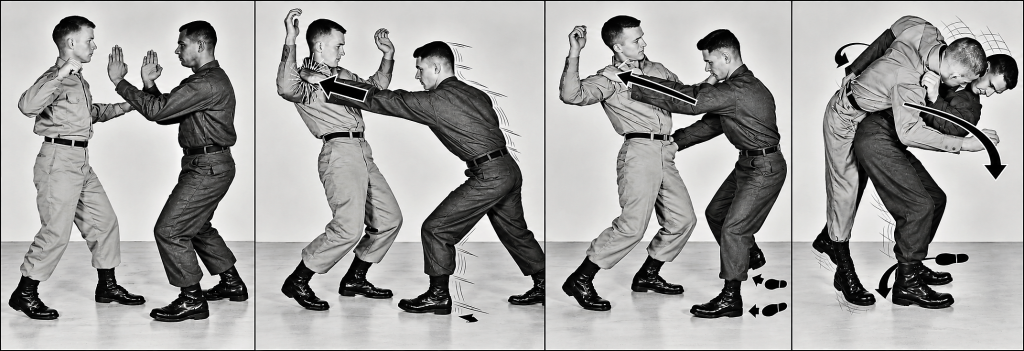
Unlike the Cross Hock Takedown and Reverse Hip Throw, these techniques require the defender to rotate into a position in front of or across the opponent. The angular step begins creating that relationship before the actual turn takes place. The defender is therefore not stepping straight forward and then beginning an entirely separate turning action. The diagonal penetration is already positioning his body for the rotation that follows.
The angular entry can be expressed as:
DIAGONAL STEP + SHOULDER STRIKE → POSTURAL DISRUPTION → ANGULAR PENETRATION → TURN → THROW
This makes the Army’s two entries much more significant than they might initially appear. They are not simply two ways of stepping while performing the same shoulder strike. The direction of the step anticipates the mechanical requirements of the throw that follows.
The linear entry favors throws requiring direct penetration, such as the Cross Hock Takedown and Reverse Hip Throw. The angular entry favors turning throws, particularly the Shoulder Throw and Hip Throw. Both retain exactly the same underlying tactical principle:
The shoulder strike creates the initial disruption; the footwork places the defender on the correct path for the throw.
That also provides an important bridge to the later progression of the lost entry. Once we recognize that the original Army method already contained both linear and angular penetration, developing the concept through an unorthodox boxer’s stance, bladed-off stance, and false lead is not a departure from the historical principle. It is an expansion of its geometry and tactical application.
Impact-Assisted Kuzushi
The shoulder strike can be understood as a form of impact-assisted kuzushi. In conventional Judo, kuzushi is commonly associated with pushing, pulling, and manipulating the opponent after grips have been established. The Army method attacks balance at an earlier point in the engagement.
The initial contact itself creates kuzushi.
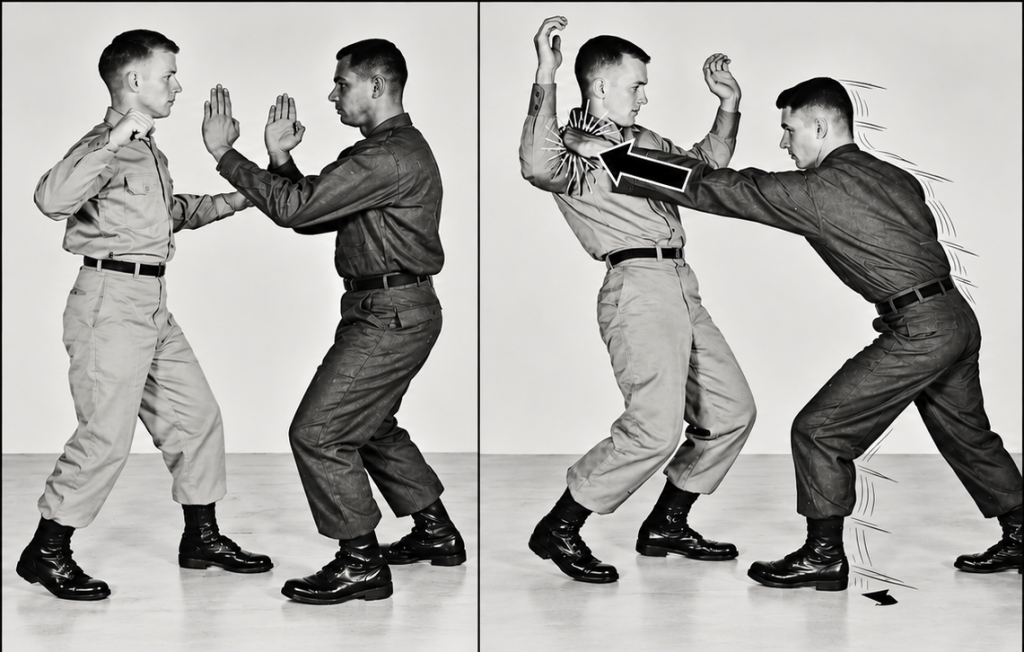
The defender’s forward or angular step supplies bodyweight and momentum to the open-hand strike. Contact against the front of the shoulder displaces the opponent’s upper body before his feet can completely compensate for that displacement. At the same time, the defender is already traveling along the line required by the selected throw.
This is what makes the distinction between the two entries so important. Kuzushi and tsukuri are beginning to overlap. The defender is simultaneously disrupting the opponent and positioning himself for the throw.
The strike is therefore not something performed before the entry.
The strike is part of the entry, and the direction of the entry is part of the throw.
In my application of the Cross Hock Takedown, for example, the hand that penetrates into the shoulder establishes the grip and immediately retracts. That extraction becomes a powerful pulling action, similar mechanically to the recovery of a hard boxing jab. The initial shoulder contact drives and disrupts the opponent away from his stable position; the immediate retraction then pulls him back toward his front and into my advancing body.

The opponent’s posture is consequently attacked in two directions within a fraction of a second:
STRIKE HIM OFF HIS BASE → CATCH HIM → PULL HIM INTO THE THROW.
This also explains why the old Army entry should be studied as a system of entry mechanics, rather than simply an unusual shoulder strike found in an old field manual. The Army was coordinating the direction of footwork, the disruption of posture, the closing of distance, and the mechanical requirements of the particular throw that followed. Linear for direct penetration. Angular for rotation.
Learn more about Combat Judo by joining the United States Combat Judo Federation. Join today at the official United States Combat Judo Federation webpage at CombatJudo.net.
A United States Combat Judo Federation Lifetime Membership (50.00 USD) gives you unlimited access to an expanding library of information devoted to Combat Judo history and techniques, including detailed technical and tactical analysis of the methods that made Combat Judo a practical fighting system.
Study the history. Understand the mechanics. Learn the application.
Join the USCJF and help us Preserve America’s Fighting Judo Heritage.