One of the most persistent criticisms leveled against Judo is surprisingly simple: “Judo won’t work if the other guy isn’t wearing a gi or a jacket.” Historically, however, the American military spent decades demonstrating otherwise. Long before modern no-gi grappling became popular, American servicemen were being taught how to strike, off-balance, throw, and take down opponents without relying upon the conventional sleeve-and-lapel grips associated with modern sport Judo.
From the military’s early exposure to Judo and Japanese Jujutsu in the first decades of the twentieth century, through World War II, Korea, and Vietnam, American military close-combat programs repeatedly adapted Judo-derived throwing mechanics to soldiers wearing ordinary military uniforms. For much of the twentieth century, the American military became remarkably proficient at something many people today insist cannot be done: Judo without the Judogi.
The Gi Is a Tool – Not the Source of the Throw
The misconception begins when we confuse the gripping conventions of sport Judo with the biomechanics of Judo itself. A Judogi provides excellent handles. The lapel and sleeve allow the Judoka to transmit force into an opponent’s body, manipulate posture, create kuzushi, maintain connection, and control rotation.
But the jacket doesn’t create those mechanical principles. The human body does. Balance remains balance whether someone is wearing a Judogi, a field jacket, a T-shirt, or no shirt at all. The hips still rotate. The shoulders can still be controlled. The head can still be manipulated. The legs can still be blocked or reaped. The body’s center of mass can still be displaced beyond its base of support. Once we understand that distinction, no-gi Judo stops appearing mysterious. The question is no longer: “How can I perform Judo without lapel and sleeve grips?”
The better question becomes: “How do I establish the necessary connection to manipulate the opponent’s body?”
The American military spent generations answering precisely that question.
American Military Judo Was Never Confined to the Dojo
The American military’s interest in Japanese throwing and grappling methods predates World War II. During the first decades of the twentieth century, Judo and Jujutsu methods increasingly appeared within military, police, and civilian self-defense instruction.
But World War II accelerated the process enormously. The military needed close-combat methods that could be learned relatively quickly and used under extremely unfavorable conditions. Soldiers were not preparing to fight barefoot on Tatami against opponents wearing Judogi. They might be wearing fatigues, field jackets, web equipment, helmets, boots, or other equipment. They could be fighting on dirt, sand, concrete, aboard ships, inside buildings, or across uneven terrain. Consequently, military Judo had to adapt.
And it did.
The result was an Americanized interpretation of Judo mechanics integrated with boxing, wrestling, striking, and aggressive close-quarter tactics. During World War II this broad family of methods increasingly became associated with terms such as Combat Judo and military hand-to-hand combat. The important point is not merely what the military called it. The important point is how the techniques were being applied.
The Soldier Didn’t Need Lapel-and-Sleeve Grips
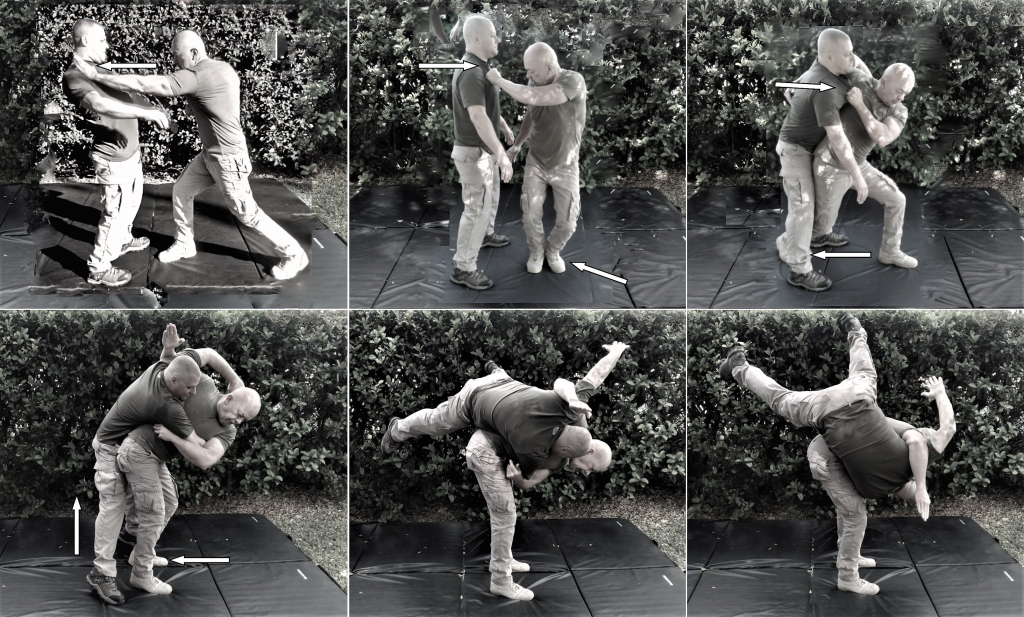
Look carefully at older military combatives material and something becomes immediately apparent. The soldier frequently isn’t establishing conventional Judo grips before attempting his throw. Instead, control may come from the opponent’s: shoulder, upper arm, elbow, wrist, neck, head, waist, belt, clothing, or torso.
Overhooks and underhooks can replace conventional jacket grips. The head and neck can become control points. The upper arm can become a lever. Military clothing itself can be seized when appropriate. But there was another method of establishing control that deserves considerably more attention:
The strike.
This is where military Judo begins looking substantially different from the Judo most people see in modern competition. They Hit Their Way Into Throwing Range Many military throwing sequences did not begin with two men establishing grips and fighting for position. They began with aggression. A strike could disrupt the opponent’s posture before the throw was attempted. That changes everything. Instead of: Grip → Kuzushi → Entry → Throw
the combative sequence could become: Impact → Posture Destruction → Attachment → Entry → Throw.
The strike itself becomes part of the throwing mechanism. It creates a neurological and mechanical reaction. The opponent’s posture changes. His weight shifts. His attention becomes occupied by the impact. His defensive structure may momentarily deteriorate. The attacker simultaneously closes distance. That moment provides the opportunity to establish physical connection and execute the throw. This is not Judo despite the absence of traditional gripping. It is an adaptation of Judo’s fundamental throwing mechanics to a different tactical environment.
The Cross Hock Takedown Is an Excellent Example
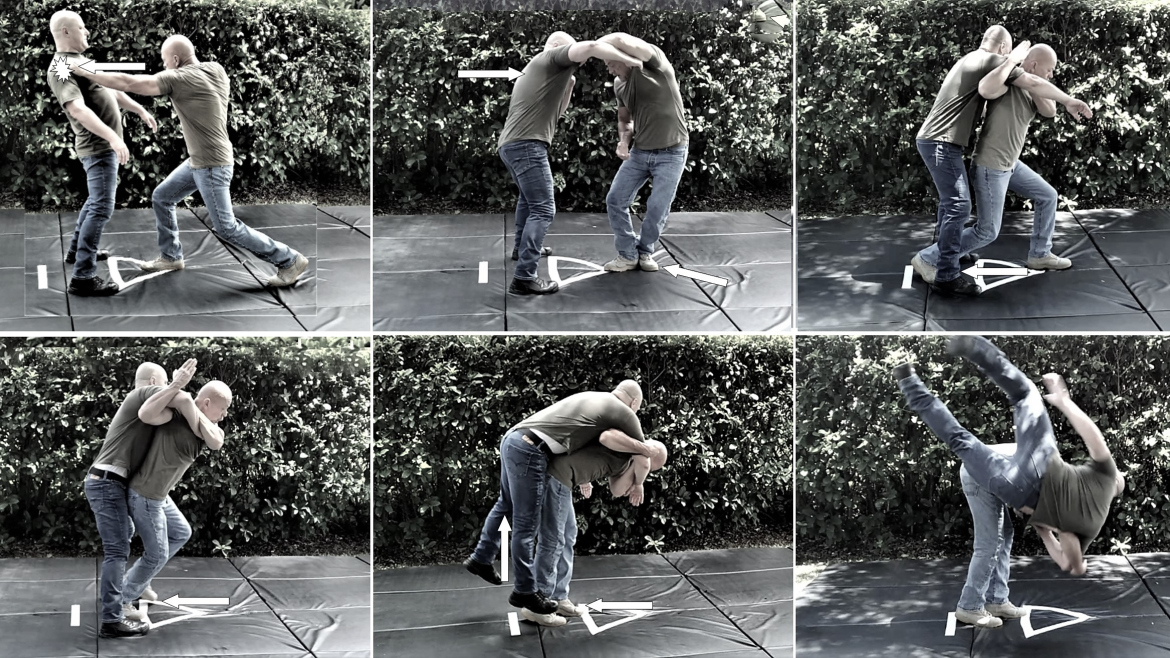
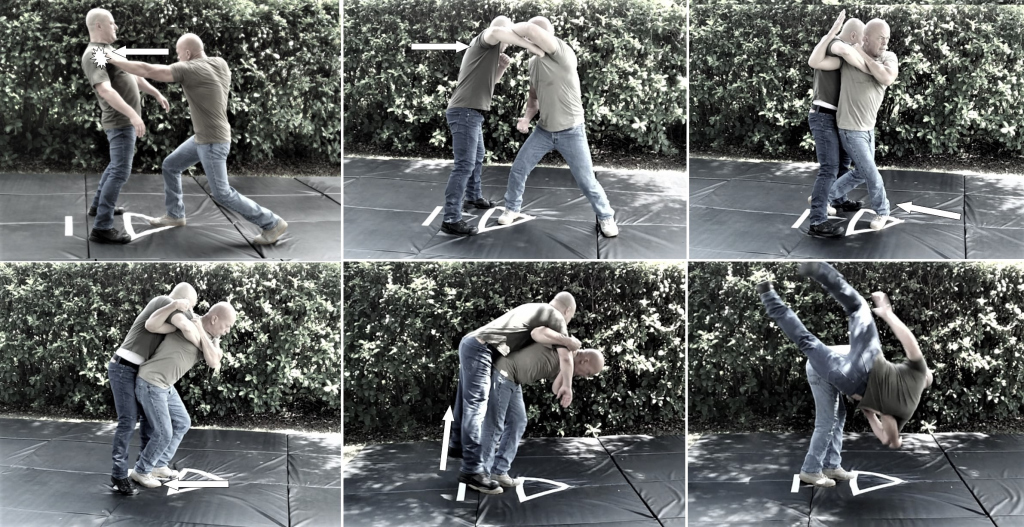
Few techniques illustrate this better than the U.S. Army’s Cross Hock Takedown. The Cross Hock has sometimes been casually compared to Judo’s Osoto Gari because both can involve attacking the opponent’s leg from the outside. But reducing the Cross Hock to simply “military Osoto Gari” overlooks much of what makes the technique tactically interesting.
The Army’s method could begin with a vigorous heel-of-the-hand strike to the front of the opponent’s shoulder. Upon impact, the clothing at the area struck could immediately be grasped. That seemingly simple instruction reveals an important piece of military combatives thinking. The soldier wasn’t necessarily expected to establish a comfortable grip first and then manufacture kuzushi. Impact helped create the kuzushi.
The striking arm then transitioned immediately into attachment and pulling control as the soldier penetrated into throwing range. The opponent’s posture was being attacked before the actual leg action occurred. That is no-gi or minimal-clothing Judo logic expressed through military combatives.
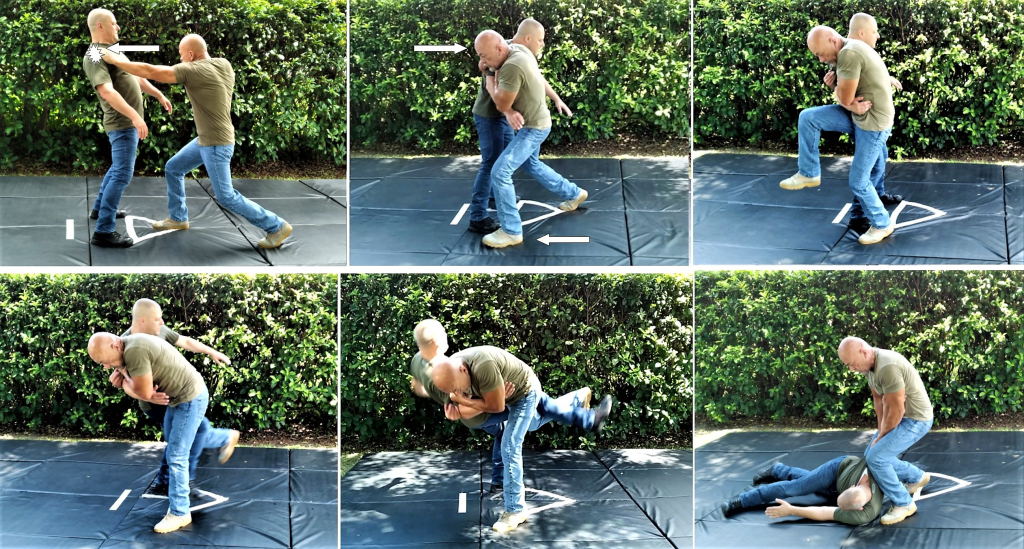
Judo Mechanics Without Judo Etiquette
There is another reason these techniques worked without a Judogi. The military wasn’t bound by sporting conventions. The soldier could strike before throwing. He could aggressively manipulate the head. He could collide with the opponent. He could use forearms, shoulders, body weight, and forward pressure. He could seize whatever clothing or equipment was available.
Most importantly, the throw wasn’t necessarily the beginning of an extended grappling exchange. The objective was to put the opponent violently onto the ground while the soldier remained capable of continuing the engagement. Military throwing therefore emphasized something that could sometimes become less obvious in technical demonstrations:
Throws are whole-body collisions governed by balance, leverage, momentum, positioning, and timing. A jacket makes controlling those forces easier. It doesn’t create them.
From World War II Through Vietnam
Perhaps the strongest historical argument against the “Judo needs a gi” claim is simply the longevity of American military throwing doctrine. This wasn’t a short-lived World War II experiment. Judo-derived throwing methods continued appearing within American military hand-to-hand combat doctrine through successive generations. World War II manuals contained extensive material involving throws, trips, locks, chokes, and methods of violently disrupting balance. The postwar Army continued developing hand-to-hand combat doctrine.
The 1954 edition of FM 21-150, Hand-to-Hand Combat, preserved a substantial throwing curriculum. The tradition continued into the Vietnam era. By the time of the 1969 and 1971 versions of FM 21-150, American military personnel had inherited decades of institutional experience adapting throwing mechanics to military close combat. That means the United States military spent a substantial portion of the twentieth century teaching soldiers to do something modern critics sometimes claim is impractical:
Throw people without needing conventional Judo grips.
So What Happened?
The interesting historical question isn’t whether the military proved no-gi Judo could work. It clearly developed numerous ways of throwing without relying upon a Judogi. The more interesting question is: Where did that institutional knowledge go?
By the post-Vietnam period, American military combatives began changing. Throws did not completely disappear. Later manuals, including the 1992 FM 21-150, still contained throws and takedowns. Therefore, saying that throwing simply “vanished” would overstate the case. Something more subtle happened.
The older, highly integrated methodology of striking into posture destruction, attaching to the opponent, penetrating immediately into throwing range, and completing the action with a Judo-derived throw or takedown became much less prominent as a coherent system. The individual pieces survived. But much of the connective tissue between them was being lost.
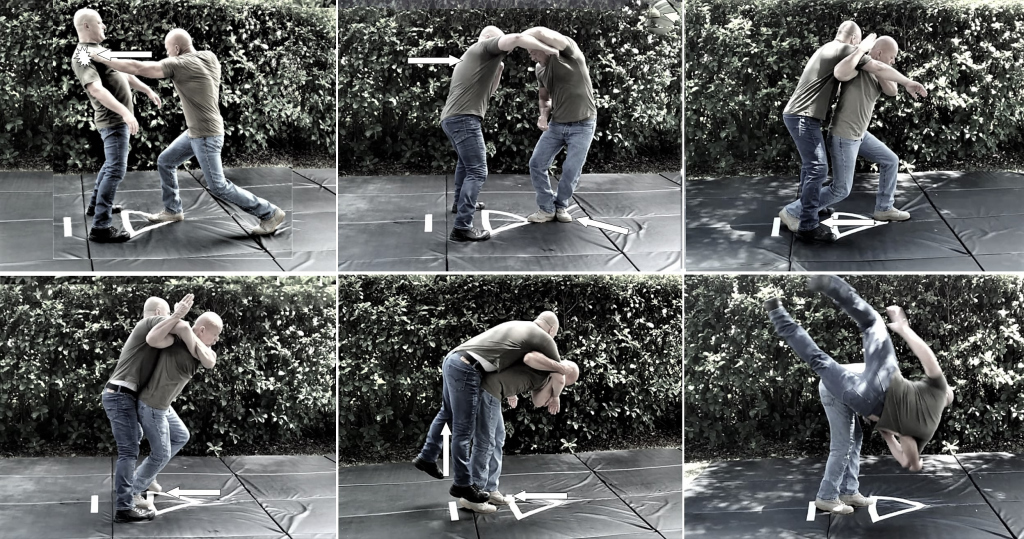
The Forgotten Skill Wasn’t Throwing
This distinction is critical. The forgotten skill wasn’t simply knowing a hip throw. It wasn’t knowing how to reap someone’s leg. It wasn’t knowing how to perform a shoulder throw. Those techniques continued to exist. What earlier generations of American military instructors had developed was the ability to transition from fighting range into throwing range without requiring the conventional gripping environment of Judo.
That is a much more sophisticated skill. They developed ways to use impact as kuzushi. They used striking to establish attachment. They learned to control anatomy instead of depending exclusively upon clothing. They combined boxing-style movement with grappling. They used aggressive forward penetration to deny the opponent time to recover his posture. In other words, they weren’t merely practicing Judo techniques without jackets. They were developing a combative delivery system for Judo.
The Gi Was Never the Problem
This brings us back to the original criticism: “Judo doesn’t work if someone isn’t wearing a gi.”
More than half a century of American military close-combat development provides a powerful historical counterargument. The Judogi is an outstanding training tool. It allows sophisticated gripping, pulling, turning, lifting, and posture manipulation. Sport Judo has developed those possibilities to an extraordinary degree.
But Judo’s underlying mechanics do not suddenly stop functioning when the jacket comes off. Gravity doesn’t change. Human anatomy doesn’t change. Balance doesn’t change. Leverage doesn’t change. Momentum doesn’t change. What changes is the method of attachment. That is the lesson earlier American military combatives understood extremely well.
Perhaps We Didn’t Need to Invent No-Gi Judo
Modern martial arts sometimes treat no-gi throwing as though it were a relatively recent innovation. American military history suggests otherwise. Generations ago, military instructors were already confronting the same problem:
How do we apply powerful throwing mechanics when conventional Judo grips aren’t available?
Their solutions were practical. Control the anatomy. Use whatever clothing is available. Strike to disrupt posture. Attach during the reaction. Close distance aggressively. Position the body correctly. Then throw.
Perhaps the real story isn’t that Judo needs to be reinvented for no-gi fighting. Perhaps we simply need to rediscover what generations of American military close-combat instructors had already figured out. The jacket was never what made Judo work. The mechanics made Judo work. And for much of the twentieth century, the American military became exceptionally good at proving it.
JOIN THE UNITED STATES COMBAT JUDO FEDERATION TODAY!
For more information on Combat Judo and related subjects.
 THREE COMBAT JUDO EBOOKS — $12.99 EACH
From the battlefields of WWII to modern combative application, explore the history, biomechanics, tactics, and techniques of Combat Judo through three books by Barron Shepherd.
🥋 COMBAT JUDO: HISTORY AND TECHNIQUES
Discover the origins and evolution of U.S. Army wartime Combat Judo.
💥 THE CROSS HOCK TAKEDOWN
A definitive historical, biomechanical, and tactical study of one of the U.S. Army’s classic combat takedowns.
🥊 REAL COMBAT JUDO
No mats. No point scoring. Pure combative application.
💳 TO ORDER VIA PAYPAL:
Send payment to: winterhavenjudo@gmail.com Please include the title of the ebook you are purchasing and email address with your payment.
LEARN. TRAIN. APPLY. WIN.


