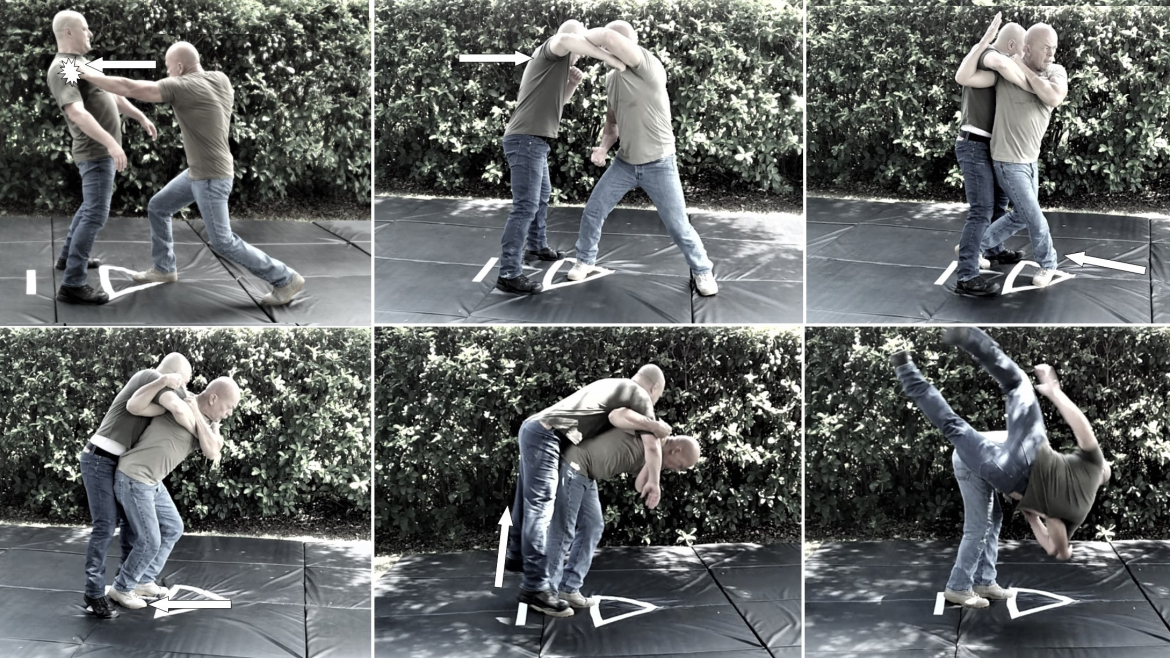
One of the most important realities is that close quarters are not always entered deliberately. Sometimes the distance between two people collapses much faster than anticipated. An opponent may rush forward, attempt a bear hug, clinch aggressively, or simply overwhelm the defender’s preferred striking distance before a conventional response can be established.
The unexpected collapse of distance is not necessarily a disadvantage. It can become the entry into the throw.
In an ideal tactical situation, the defender recognizes the attack early enough to control distance, establish an angle, strike, disrupt posture, and then enter into the takedown. Real confrontations are rarely that orderly. An aggressive opponent can cover several feet extremely quickly. Suddenly the defender may find himself chest-to-chest or nearly chest-to-chest before he has had time to establish the preferred striking or gripping structure.
The First Technical Priority: Build a Frame
The first sequence is for the defender to bring the hands, forearms, and elbows between himself and the attacker while dropping into an athletic posture, specifically keeping the knees bent and the belt line below the attacker’s. This is technically significant.
When the gap suddenly disappears, the hands may not have enough room to chamber a meaningful punch. The forearms and elbows, however, can still function within extremely compressed space.
The defender is essentially constructing a structural wedge between his torso and the incoming opponent. Rather than trying to stop the opponent with arm strength alone, the defender connects the arms to the skeletal structure of the torso and legs. Bending the knees and lowering the center of mass also makes it more difficult for the attacker’s forward pressure to force the defender upright or backward.
The objective is not merely “blocking a bear hug.” It is preventing the opponent from establishing dominant chest-to-chest control while simultaneously creating the structure necessary for the counterattack.
The Forearm Creates Working Space
From a technical standpoint, the forearm performs several functions simultaneously. It creates separation between the upper bodies, interferes with the attacker’s forward posture, and gives the defender enough room to begin rotating into the shoulder throw.
This is an important Combat Judo concept: Space does not necessarily have to be created by backing away. Space can be created inside the clinch.
That is particularly valuable when there is nowhere to retreat, against a wall, between vehicles, inside a hallway, around furniture, or simply because the opponent has already penetrated too deeply.
Shoulder Throw (Ippon Seoi Nage) – Split Entry VS. Front Bear Hug
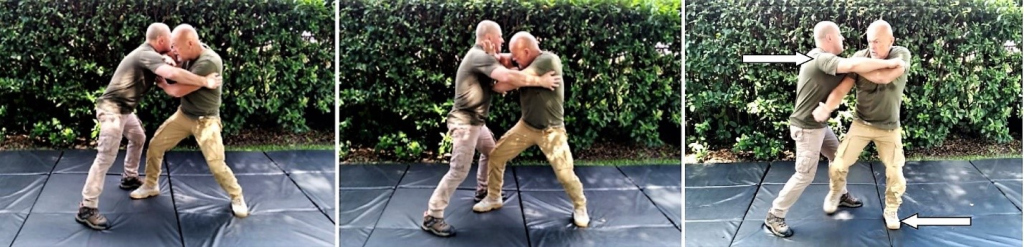 1.) The attacker moves in, left foot forward to bear hug. From a right foot forward bladed off stance, Bring your hands and forearms and elbows up and between you and the attacker. Get in a good athletic posture.
Note: Your knees should be bent and your belt line should be lower than the attacker’s beltline.
2.) Create space by driving the boney area of the right forearm into the attacker’s neck or throat. The left hand grabs the attacker’s shirt at the pocket of the shoulder, above the armpit. 3.) Pull the attacker into you with the left hand, at the same time that you bring the rear (left) foot up toward the lead (right) foot. As the left foot lands, then bring the right knee up toward the chest as you pivot counter clockwise of the left foot. The right hand goes under the attacker’s right arm.
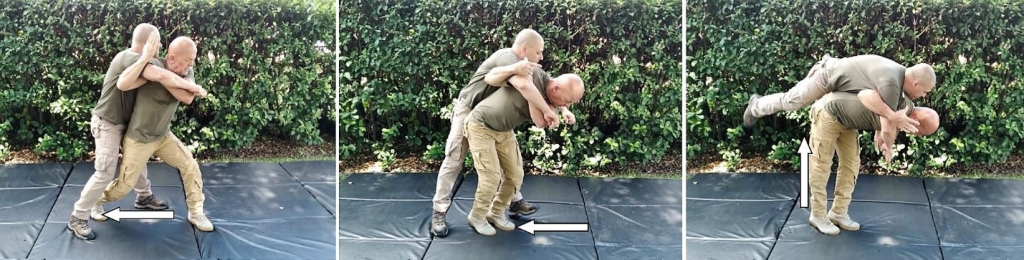 4.) The right foot steps back deep between the opponent’s feet and to the inside of the opponent’s right foot. Pinch the attacker’s right arm at his armpit in the crook of your elbow. Clamping on the attacker’s arm with your forearm arm and bicep.
Note: When the right foot makes contact with the ground, the toes of both of your feet should now be pointing in the direction of your throw. Your belt line should be below his belt line and the attacker’s right arm is pinched in the crook of the elbow pinched between your right bicep and forearm.
5.) Continue to pull with your left hand as you step your left foot back next to your right foot.
Note: As the left foot goes back the attacker will start to come up off his feet.
6.) Straighten your legs popping your hips upward and pull your left elbow toward your left hip to finish the throw.
The Elbow as an Emergency Interception Tool
At extreme range compression, economy of motion becomes critical. There may simply be insufficient time or space to chamber a conventional strike. The elbow is already close to the attacker’s body and can therefore be integrated directly into the defensive structure. Technically, this makes the elbow less of a separate “strike followed by a throw” and more of a transitional action connecting interception to kuzushi and entry.
The opponent closes. The defender establishes structure. The elbow disrupts posture. The controlling hand pulls. The feet reposition. The body rotates. The throw follows. These actions should increasingly overlap rather than occur as isolated steps.
The Elbow Crash: Turning the Collision Against the Attacker
Rather than waiting passively for the opponent’s forward movement to overwhelm him, the defender brings the elbow into alignment with the incoming attacker and drives from the rear foot so that the opponent effectively crashes into the defensive structure. The document emphasizes maintaining athletic posture during that collision. This changes the tactical equation.
Instead of: Attacker closes → Defender retreats
the sequence becomes: Attacker closes → Defender intercepts → Collision disrupts attacker → Defender enters deeper
The opponent’s aggression therefore helps produce the conditions for the takedown. There is an important biomechanical principle involved here. When two bodies are moving toward one another, the relative closing velocity increases. The defender does not necessarily need a large striking motion. A relatively compact structure can become powerful because the opponent is contributing momentum to the collision. That makes the elbow crash particularly compatible with extreme CQB.
Why the Shoulder Throw Fits the Situation
The split-entry Ippon Seoi Nage makes tactical sense once the opponent has already compressed the distance. The defender is not attempting to manufacture throwing range from several feet away. The attacker has effectively delivered himself into close throwing range.
The technical problem therefore becomes getting underneath and inside the attacker’s center of mass before the attacker can stabilize the clinch. There are several critical mechanical details: the defender’s belt line remains below the attacker’s; the throwing foot penetrates deeply between the opponent’s feet; the opponent’s arm is tightly captured in the crook of the elbow; and the legs and hips elevate while the pulling arm continues downward toward the hip.
Those mechanics are particularly important against a rushing opponent because the throw should not become an attempt to muscle him over the back. The legs establish the vertical component. The rotation establishes direction. The arm control connects the opponent to the throwing structure. The pulling action keeps the opponent moving into the throw.
The Split Entry and Emergency Footwork
The split entry is also valuable when the distance has collapsed unexpectedly because it allows the defender to build the throwing position progressively. The rear foot first comes toward the lead foot. The knee rises as the defender pivots, and the throwing foot subsequently penetrates deeply between the opponent’s feet. Rather than requiring a large turning circle, the defender compresses his footwork underneath himself. That is exactly what extreme close quarters demands.
The tactical rule becomes: When space disappears, movement must become smaller—not slower. The feet travel shorter distances while the hips and torso rotate aggressively.
Pulling the Opponent Into the Space You Just Created
There is an apparent contradiction in the sequence that is actually one of its strongest features. The defender initially creates separation with the forearm or elbow, but immediately afterward pulls the attacker back toward himself.
Why create space only to close it again?
Because these are two different kinds of distance. The first action creates enough functional space for the defender to move his own body. The subsequent pull eliminates the opponent’s ability to recover that space. The defender is essentially replacing the attacker’s clinching position with his own throwing position.
So the defender is not escaping the close range. He is reorganizing it.
The Central Combat Judo Principle
This sequence demonstrates something larger than simply “Ippon Seoi Nage against a bear hug.” It addresses one of the most difficult moments in a physical confrontation: the instant when the opponent gets closer than expected, faster than expected.
At that point, there may be no clean punching range and insufficient time to establish a conventional Judo grip. The defender has to work with the contact that already exists. That is where Combat Judo’s integration of striking, posture disruption, gripping, footwork, and throwing becomes particularly useful.
The progression demonstrated in the PDF can therefore be understood as:
COLLISION → STRUCTURE → POSTURE DESTRUCTION → CONTROL → ENTRY → THROW
The opponent’s rapid advance creates the collision. The defender’s forearms and elbows prevent that collision from becoming an uncontrolled clinch. The forearm or elbow disrupts posture. The gripping hand establishes control. Compact footwork gets the defender underneath the attacker’s center. The pull and rotation continue the opponent’s movement into the throw.
The final page illustrates this particularly well: after the crash, the defender steps inside, pivots, establishes a lower belt line and deep foot position, elevates with the legs and hips, and continues the pulling action to complete the shoulder throw.
Tactical Conclusion
The most important lesson from these sequences is simple:
When the gap closes faster than you expected, you do not necessarily need to recreate the distance you lost.
Combat Judo allows the practitioner to fight effectively inside that collapsed distance.
The forearms become frames. The elbows become striking and intercepting tools. The clinch becomes a source of control. The opponent’s forward pressure becomes momentum. And the collision itself can become the entry into the throw. This is why close-quarter Judo should not merely be viewed as conventional Judo performed in a smaller space. The tactical objective has changed. Instead of establishing ideal gripping distance and then creating kuzushi, the defender uses the violent and unexpected collapse of distance itself to begin creating kuzushi.
In that sense, the attacker rushing into extreme close quarters has not necessarily taken away the Combat Judoka’s throwing opportunity. He may have just provided it.
JOIN THE UNITED STATES COMBAT JUDO FEDERATION TODAY!