One of the most useful concepts preserved in older American military Judo is the use of contact during the entry. Rather than simply stepping into position and then attempting to throw an opponent, the entry itself is used to interfere with the opponent’s posture and movement.
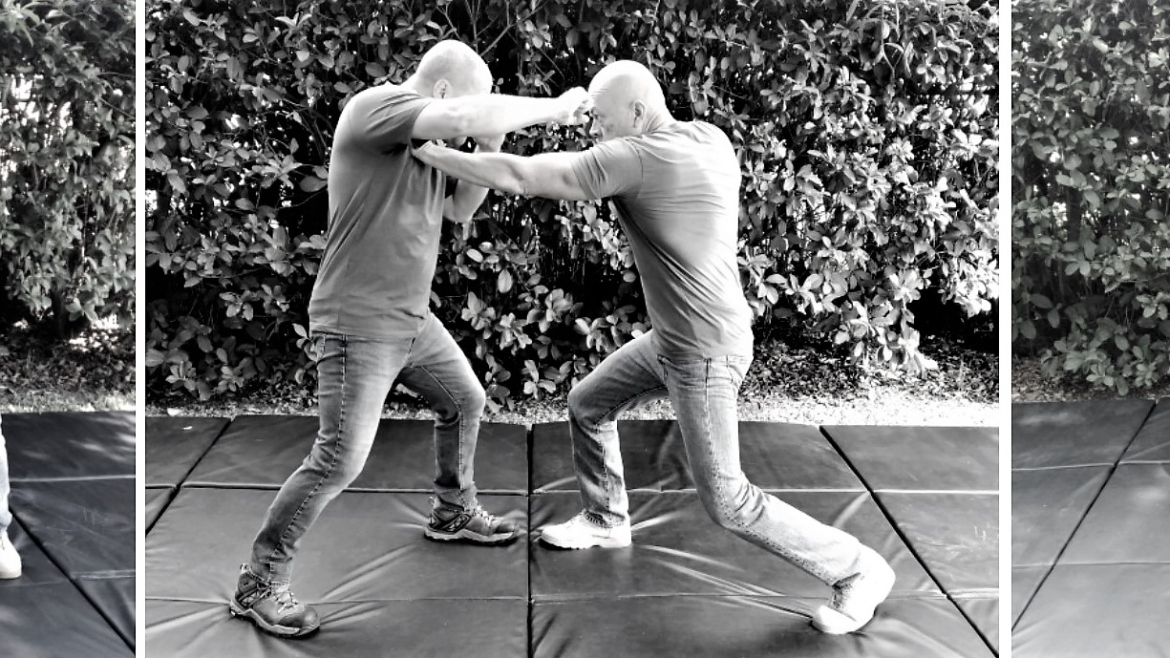
A particularly good example is what I refer to as the shoulder stop. The concept can be found in the older U.S. Army hand-to-hand combat material, where the soldier advances while making forceful contact with the opponent’s shoulder before continuing into the takedown. When this principle is combined with the basic step-pivot method of entering a Judo throw, it becomes much more than a historical military technique. It becomes a bridge between Combat Judo and conventional Judo performed in a gi.
The Shoulder Stop Is Part of the Entry
The shoulder stop should not be viewed as one technique followed by another. It is not: Strike the shoulder. Stop. Establish a grip. Stop. Enter. Stop. Throw. The actions should flow together.
The forward step brings the Judoka into contact. The hand makes forceful contact with the front of the opponent’s shoulder. That contact disrupts posture and interferes with the opponent’s ability to move freely. The hand immediately establishes control, and the arm retracts as the body continues forward into the pivot.
The shoulder stop, pull, step, pivot, and throw therefore become parts of a single continuous entry.
This is important because the purpose of the shoulder stop is not merely to strike the opponent. Its greater tactical value is that it allows me to begin manipulating the opponent’s structure while I am closing the distance necessary to throw him.
The Basic Step-Pivot Method
The basic step-pivot entry is one of the fundamental methods for entering turning throws in Judo. From a fighting position, the lead foot advances into the appropriate position relative to the opponent. The body then pivots as the second foot moves into position, allowing the hips and torso to rotate in front of or underneath the opponent.
Normally, kuzushi, foot placement, rotation, and fitting into the throw are taught as closely connected actions. Adding the shoulder stop makes that relationship even more pronounced. Instead of entering against an opponent who remains structurally undisturbed, attack the opponent’s posture at the same moment you begin your entry. The shoulder contact therefore becomes an integral part of the mechanics of the step-pivot.
Contact Before Rotation
This sequence is especially important. The shoulder stop occurs before the major rotation of the throw. As you step forward, your hand makes contact with the front of the opponent’s shoulder. The contact checks his movement and begins disturbing his upper-body alignment. Then grasp the opponent’s shirt at the area struck and immediately retract the arm.
I have often described this action as similar to punching the grip into position like a boxer and then retracting it. The hand does not simply reach out and settle onto the opponent. It arrives with purpose and immediately transitions into pulling pressure.
That retraction draws the opponent toward you while your body continues moving toward him. The two bodies are therefore not moving independently. You are entering into him while simultaneously pulling him into your entry. This can significantly reduce the space that must be crossed before the throw.
Creating Kuzushi Through Collision and Retraction
This also changes the way kuzushi is produced. Rather than depending entirely upon pulling an opponent from a relatively stable position, the shoulder stop begins the disruption through contact, forward pressure, and interruption of posture. The immediate retraction then redirects that disruption.
The opponent experiences two closely connected forces:
contact that checks or displaces his upper body, followed immediately by pulling pressure that draws him toward the throw.
Meanwhile, your feet never stop working. The initial step closes distance. The pivot changes your orientation. The second foot establishes the throwing position. The rotation of the hips and torso then continues the direction already created by the shoulder stop and pull. This is why the shoulder stop should not be isolated from the footwork. The hands and feet are solving the same tactical problem.
Application in Combat Judo
In Combat Judo, this method has obvious advantages. Distance is dangerous. Standing outside an opponent and attempting to establish perfect grips before entering may give him additional opportunities to strike, grab, disengage, or otherwise react. The shoulder stop allows the Combat Judo practitioner to enter behind purposeful contact.
The first contact is already doing work. It can interfere with posture, interrupt movement, occupy the opponent’s upper body, and establish the control necessary for the takedown. The basic step-pivot then carries the practitioner through the opponent’s space and into throwing position.
Instead of thinking:
close distance → establish control → create kuzushi → enter → throw
the process becomes compressed:
close distance + make contact + disrupt posture + establish control + enter.
The throw becomes the continuation of the entry rather than an entirely separate phase. That compression of actions is extremely valuable in a combative environment.
The Same Principle Works in a Gi
Where this becomes particularly interesting is its application to conventional Judo. There is sometimes an assumption that military Judo concepts belong exclusively to self-defense or battlefield combatives. The underlying biomechanics do not suddenly stop working when both practitioners put on a Judogi.
The gi actually provides an excellent control surface for applying the same principle. Instead of merely reaching for the opponent’s lapel or upper gi and then beginning the attack, I can drive the gripping hand into position with the same purposeful shoulder contact.
The contact disrupts posture. The hand establishes the grip. The immediate retraction begins kuzushi. At the same time, my feet are already entering. This means the grip acquisition itself can become part of the attack.
Rather than: grip first, attack second, the grip and attack begin to merge.
Shoulder Throw (Stepping straight in with right foot) – Step and Pivot
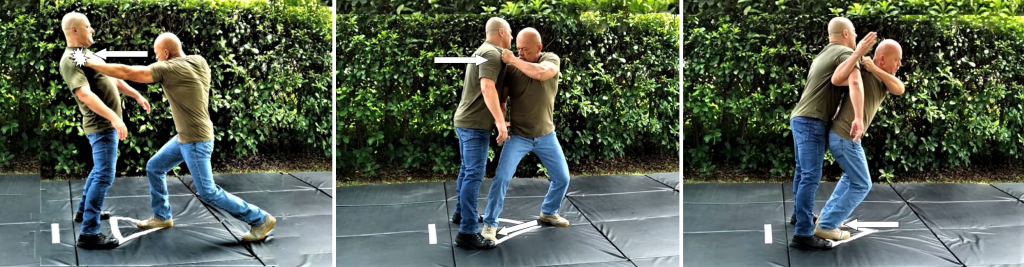
1,) From a ready position, much like delivering a cross in boxing, push off the left foot and step forward straight into the apex of the triangle with your right foot and strike the aggressor’s shoulder right above the armpit (the strike should rock him back on his heels) and then grip his shirt at the area struck. Your right hand is up protecting the right side of your face.
2.) Pull the aggressor back toward you with the left hand rocking him forward up off his heels. At the same time as you pull, the left foot moves up to the top of the triangle just behind your right foot. Simultaneously, step your right foot to his right foot. The toes of your right foot should be almost touching the inside of his right foot, next to his big toe. Your belt line should be lower that the opponent’s belt line. Your right arm moves under the aggressor’s right armpit. As the right foot touches the ground start to pivot counter clockwise on the ball of the right foot.
3.) As you Pivot counter – clockwise on the ball of your right foot as if cork screwing into the ground, continue to pull with the left hand. Your left foot steps or sweeps back all the way through the triangle between the opponent’s feet. The toes of both feet should be pointing in the direction of the apex of the triangle. Your back should be flat against the opponet’s chest. Pinch the opponent’s right arm at his arm pit between your right forearm and bicep. Rotate the palm of the right hand toward your head (this creates a tighter clamp on the opponent’s arm).
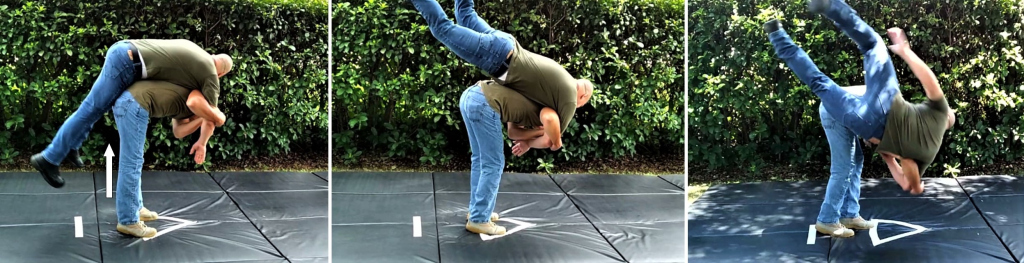
Steps 4.) and 5.) Pull downward with your right hand as you straighten your legs quickly by driving upward off your heels, popping your hips upward into the opponent.
6.) To finish the throw, continue to pull and twist your torso by turning your right elbow toward your left knee and drive the opponent to the ground.
Applying It to Sport Judo
In randori or sport application, the shoulder stop does not have to be treated as a damaging strike. It can be expressed through assertive legal gripping contact and pressure consistent with the rules under which one is training or competing.The important principle is not simply hitting the shoulder. The principle is using the moment of contact to affect the opponent’s structure before completing the entry. That distinction is important.
Combat Judo may employ the shoulder contact more aggressively because its tactical environment is different. Sport Judo operates under rules governing gripping, striking, and allowable actions.
But the underlying mechanics remain remarkably similar:
contact → disruption → grip → retraction → entry → rotation → throw.
The intensity and exact expression change according to the environment. The principle does not.
Why the Step-Pivot Is an Ideal Starting Point
I have also incorporated the shoulder stop into more advanced Judo entry methods, including split-step and back-step entries. Those methods can make the concept faster, more deceptive, and more adaptable. However, the basic step-pivot remains one of the best ways to understand the principle. Its relatively simple footwork makes the relationship between upper- and lower-body mechanics easy to see. The student can feel how the advancing step supports the shoulder contact. He can then feel how the retraction of the gripping arm works with the pivot. Finally, he can feel how the rotation of the body continues the kuzushi that began with the initial contact. Once that relationship is understood, the same principle can be incorporated into increasingly sophisticated entries.
An Old Military Concept with Modern Application
This is one of the reasons I believe the old U.S. military Judo material deserves considerably more study than it often receives. The soldiers who developed and taught these methods were concerned with a fundamental problem:
How do you get close enough to throw someone who may be actively trying to hurt you?
Their answer was not always to separate striking, gripping, kuzushi, and throwing into independent skills. They frequently connected them. The shoulder stop is an excellent example. When combined with the basic Judo step-pivot, it demonstrates how contact can create the conditions for the throw while the practitioner is still entering.
For Combat Judo, that means a faster transition from engagement to control and takedown.
For Judo in a gi, it offers another way of understanding grip acquisition, kuzushi, distance closing, and entry as interconnected actions rather than separate phases.
That is ultimately what makes the shoulder stop so valuable. It is not simply an old military trick. It is a method of entry. And when properly integrated with Judo footwork, the same principle can move seamlessly from the historical military method, to modern Combat Judo, and onto the Judo mat.
Gi Application
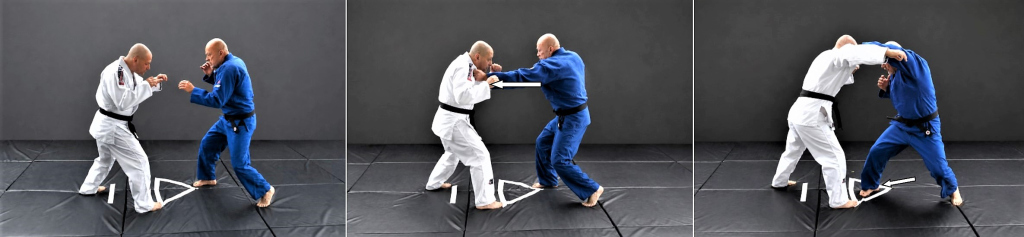 1.) Blue is standing in a right foot forward lead. Blue’s knees are bent and his center of gravity low. Twist the upper body clockwise bring the left hand and shoulder to the front closer to the opponent. In a right vs. right situation your right shoulder should be more toward your rear and not out front and easily accessible for your opponent to grip and attack.
2.) Blue punches in with the left hand and grips the opponent’s gi right above the armpit. Blue’s right hand is up and defending any attempts by the opponent to get his grip.
3.) Immediately after the getting the grip, Blue pulls the opponent with the left hand rocking him forward up off his heels. Simultaneously, Blue steps his right foot to his opponent’s right foot. As Blue steps in with his right foot his knees are bent more and his belt line should be lower than his opponent’s belt line.
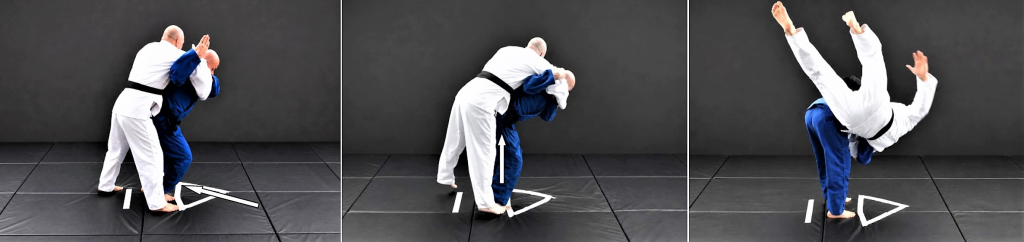 4.) Blue’s right arm moves under the opponent’s right armpit as he pivots counter clockwise on the ball of his right foot. Blues left foot steps back all the way through the triangle between the opponent’s feet as he continues his pull. Blue pinches the opponent’s right arm at his arm pit between his right forearm and bicep. Blue rotate the palm of the right hand toward your head (this creates a tighter clamp on the opponent’s arm).
5.) Blue then straighten his legs quickly and pops his hips upward into the opponent.
6.) To finish the throw, Blue continues to pull and twists his torso to the left, taking his right elbow toward his left knee and drives the opponent to the ground.