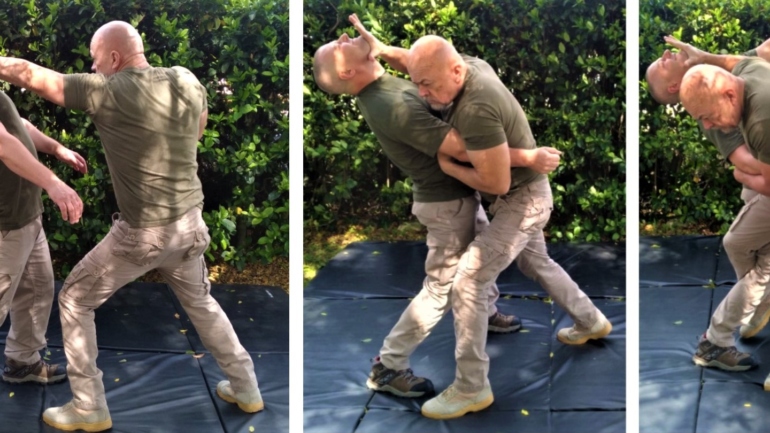
This variation of the Cross-Hock Takedown combines a false-lead fighting position, an offline entry, a strike-and-grip action to the front of the shoulder, an immediate extraction pull, a close-range headbutt, elbow control, and a linear chopping action of the leg. The technique succeeds because these actions are not performed as separate movements. Each phase preserves or increases the opponent’s postural disadvantage while the defender advances into throwing range.
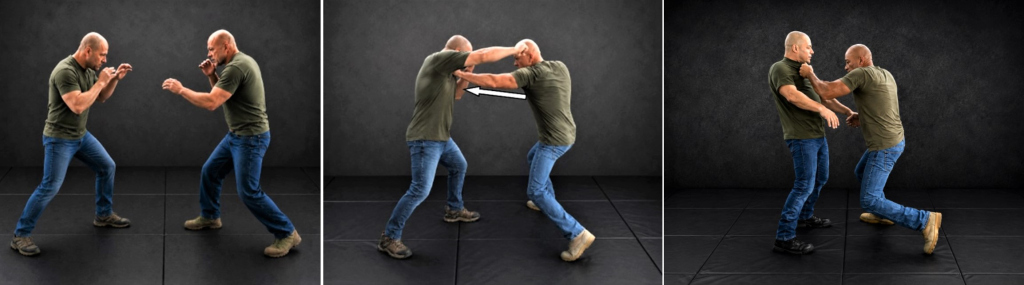 1.) The attacker assumes a left-lead fighting position. The defender adopts a false lead, placing the right foot forward while keeping the left hand prepared to intercept, strike, and attach.
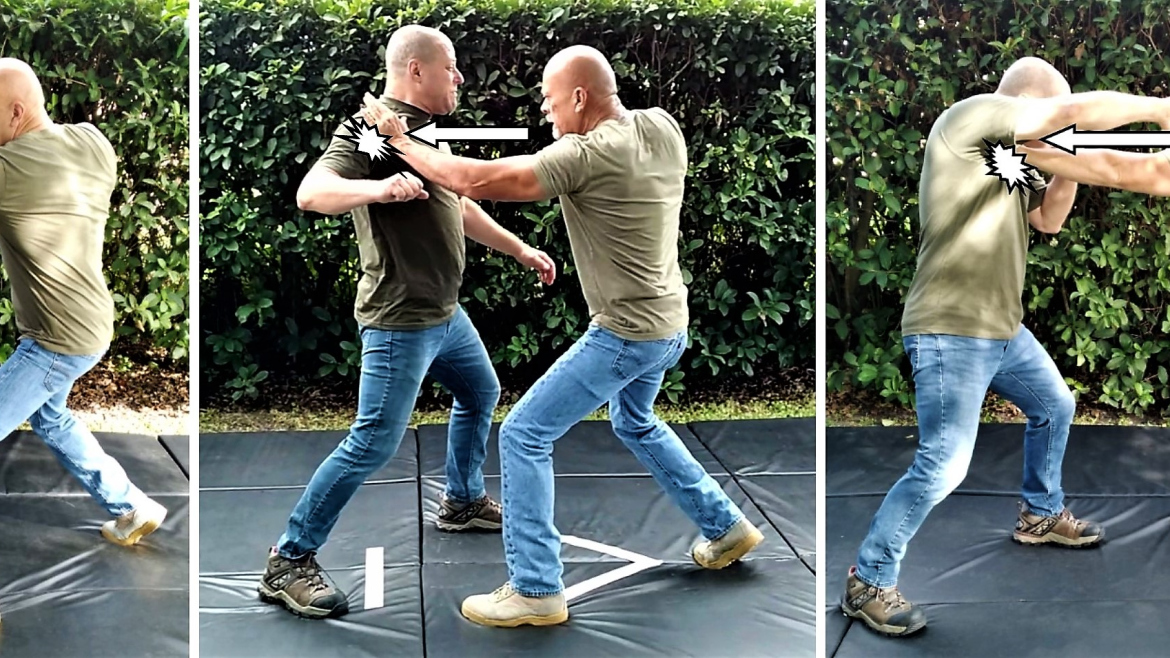
2.) As the attacker steps forward with the left foot and throws a right-hand punch, the defender steps diagonally to the right, moving outside the direct line of attack. At the same time, the defender drives the left hand into the front of the attacker’s right shoulder. The impact checks the forward attack and rocks the attacker backward toward the heels. The defender immediately secures the clothing at the point of contact.
3.) The defender retracts the left hand as if recovering a forceful jab. Because the hand has attached to the clothing, this retraction becomes a sharp pull that draws the attacker back toward the defender’s front. Simultaneously, the defender drives from the right foot. The pull and forward drive close distance while preventing the attacker from freely restoring posture.
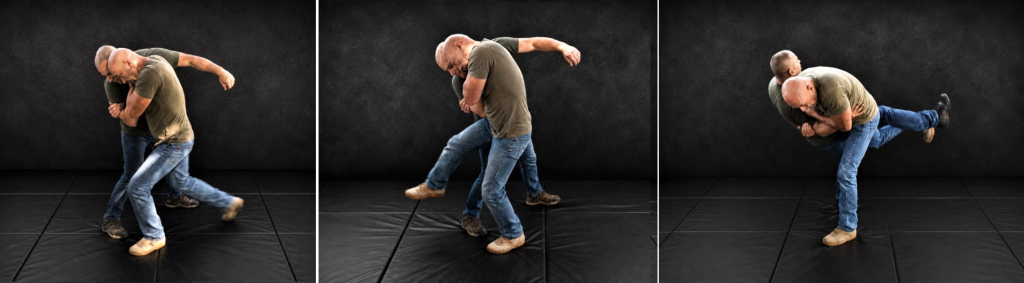 4.) Continuing the forward drive, the defender steps the left foot toward approximately 11 o’clock and delivers a close-range headbutt with the hard-upper portion of the forehead into the attacker’s face or side of the head. At the same time, the defender threads the right arm beneath the attacker’s right arm and secures control near the elbow.
5.) The defender pulls the attacker’s right elbow across the front of the attacker’s body. This action turns and folds the upper torso, limiting the attacker’s ability to square the hips or recover an upright base. While maintaining upper-body pressure, the defender lifts the right knee high and positions the lower leg behind the attacker’s right leg.
6.) The defender drives the right leg downward and backward in a direct chopping action, knocking the attacker’s right leg from beneath the compromised base. Upper-body control continues through the finish so that the opponent is directed to the ground rather than merely kicked off balance.
Technical Analysis
The False Lead
The false lead places the defender in a tactically deceptive relationship to the attacker. The forward right foot supports a rapid drive to the defender’s right, while the left hand remains aligned to strike the attacker’s right shoulder. This reduces preparatory movement and allows defense, impact, attachment, and entry to occur in one continuous beat.
Strike Grip and Retraction
The shoulder contact is more than a block. It interrupts the attacker’s advancing structure at the upper end of the torso. The immediate grip prevents the striking hand from becoming inactive after impact. When the defender retracts the hand, the action reverses the attacker’s momentum: first the shoulder is driven backward, then the attached upper body is pulled forward. This rapid change of direction makes postural recovery more difficult and draws the attacker into the defender’s penetration step.
The 11 O’clock Line
The diagonal step toward 11 o’clock carries the defender past the strongest line of the punch and into close range at the attacker’s right side. It also aligns the defender’s body to control the attacking arm and place the chopping leg behind the attacker’s right leg. The direction is functional rather than absolute; the exact angle should adjust to distance, stance width, and the attacker’s movement.
Headbutt as Transitional Disruption
The headbutt is inserted during penetration, not treated as a pause before the throw. Its tactical purpose is to interrupt orientation, defensive hand use, and postural recovery while the defender secures elbow control. The defender must keep the cervical spine aligned and strike with the hard upper forehead rather than the face, nose, mouth or front of forehead. Because this action can cause severe injury, it belongs to combative application and controlled training progressions, not routine partner practice.
Elbow Control and Rotational Denial
Drawing the attacker’s right elbow across the torso binds the shoulder line to the defender’s forward pressure. This prevents the attacker from easily retracting the arm, turning back into the defender, or widening the base with the upper body. The pull also keeps the attacker’s weight committed over the leg that will be attacked. Effective elbow control therefore links the headbutt to the takedown and preserves disruption from entry through finish.
The Cross Hock Leg Action
The finishing action is a linear chop rather than the broad reaping arc associated with a conventional osoto gari. The defender first lifts the knee to clear and position the leg; the lower limb then travels downward and backward through the attacker’s supporting leg. The leg action is most effective after posture and weight distribution have already been compromised by the shoulder strike, extraction pull, diagonal drive, headbutt, and elbow control.
Biomechanical Analysis
The technique uses sequential force transfer from the ground upward. The defender pushes from the right foot, transmits force through the hips and trunk, and expresses it through the left-hand pull, forward-moving head and shoulder line, and right-arm elbow control. The attacker is subjected to opposing forces: the upper body is pulled and rotated across the front while the supporting leg is removed downward and backward. This separation between the direction of the upper body and the loss of the lower base creates the takedown.
Balance is compromised in three dimensions. The initial shoulder strike shifts weight rearward. The extraction pull reverses that shift and draws weight forward. The diagonal penetration adds lateral displacement and rotation. Finally, the leg chop removes the post under the loaded side. The value of the sequence lies in this accumulation: no single action must produce the entire takedown by itself.
Tactical Analysis
The method is designed for a close-range combative exchange in which the defender must survive the punch, seize initiative, and prevent the attacker from resetting. Stepping offline reduces exposure to the initial line of attack. Striking and attaching in the same motion avoids a separate grip-fighting phase. The headbutt occupies the attacker during the transition to two-point upper-body control, and the Cross Hock finish brings the attacker to the ground without requiring the defender to turn the back fully across the attacker.
The technique is strongest when performed as uninterrupted forward pressure. Hesitation after the shoulder strike allows the attacker to regain posture, retract the punching arm, widen the stance, or counter. Likewise, attempting the leg chop before securing the upper body reduces the action to a kick against a stable opponent. The tactical sequence is therefore: evade the primary line, disrupt, attach, reverse the posture, penetrate, control the elbow, remove the base, and maintain command through the fall.
GO DEEPER INTO COMBAT JUDO
The United States Combat Judo Federation membership gives you unlimited access to an expanding library of information devoted to Combat Judo history and techniques, including detailed technical and tactical analysis of the methods that made American Combat Judo a practical fighting system.
Study the history. Understand the mechanics. Learn the application.
Join the USCJF and help us Preserve America’s Fighting Judo Heritage.