Understanding the Cross Hock as a Distinct Combative Takedown
The Cross Hock Takedown occupies an interesting position in the history of American military hand-to-hand combat. At first glance, the technique bears a superficial resemblance to Judo’s Osoto Gari, particularly because both methods attack an opponent’s leg from the outside while directing the opponent toward the rear. That visual similarity, however, can obscure important differences in their biomechanics and tactical execution.
A closer examination of the Cross Hock reveals a technique built around a distinctly combative sequence: impact, immediate control, rapid reversal of force, forward pressure, and a forceful attack against the opponent’s supporting structure.
The Cross Hock should therefore not be analyzed solely by looking at its final position. Its identity is found in the entire sequence of actions that produces the takedown.
At its core, the Cross Hock can be summarized as:
Enter → Strike → Grasp → Extract/Pull → Chop → Collapse.
Each component contributes to the next. Rather than establishing balance breaking as a separate preparatory phase, the Cross Hock attempts to manufacture instability through the attack itself. The important point is that the strike, grab, retraction, forward entry, and leg chop are not separate actions. They form a single kinetic sequence.
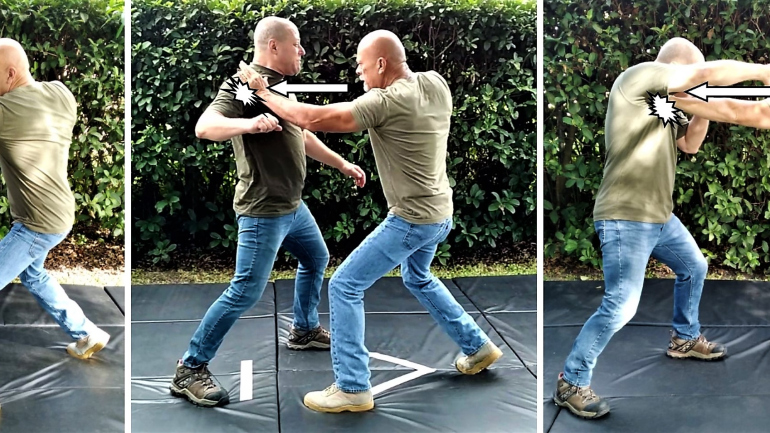
Frames 1 and 2: The strike creates the first disruption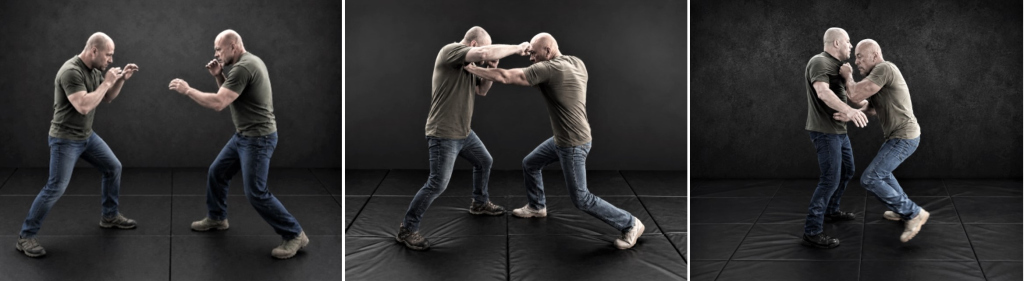
From the False Lead, the heel of the hand is driven vigorously into the front of the opponent’s shoulder as the practitioner advances. This is not merely a hand placement preceding the takedown. The strike introduces force into the shoulder girdle and upper torso, disturbing the opponent’s postural alignment and forcing an immediate balance correction. Because the practitioner is stepping into the action, the strike can incorporate forward body momentum rather than relying only on the arm.
So the Cross Hock begins with: Forward movement + impact = immediate postural disruption.
The strike immediately becomes the grip
The critical mechanical transition occurs at impact. Instead of striking, withdrawing the hand completely, and then reaching back out to obtain a grip, the hand closes on the opponent’s clothing at approximately the point where the strike lands. That eliminates an entire intermediate movement.
The sequence is not: Strike → Withdraw → Reach → Grab → Pull.
It is: Strike → Grab → Retract/Pull.
That economy of motion is central to the Cross Hock.
Frame 3: The extraction of the strike becomes the pull
This is where the boxing comparison becomes especially useful. After delivering a powerful straight punch or jab, a boxer rapidly retracts the striking hand. In the Cross Hock, the striking arm performs a similar extraction—but now the hand is attached to the opponent’s clothing. Consequently, the recovery of the strike becomes a grappling action. As the arm retracts, the opponent comes with it. This creates a rapid transition from compression to traction: Impact → Attachment → Reversal of Force → Pull.
The opponent initially has to respond to being driven by the strike. Almost immediately, the direction of force changes as the practitioner pulls him back toward his front and into the developing Cross Hock. That rapid reversal makes postural recovery more difficult.
You move into him while pulling him into you
This is one of the most important mechanics of the Cross Hock. The practitioner does not pull the opponent while remaining stationary. The pull occurs while the practitioner continues advancing.
Therefore, two movements occur simultaneously:
You are moving toward the opponent.
The opponent is being pulled toward you.
The distance between the two bodies consequently collapses from both directions. This is mechanically more efficient than attempting to cover the entire distance through forward stepping alone. The pull effectively brings the opponent into the takedown while the practitioner moves into the takedown.
The pull is both kuzushi and distance management
This means the pulling action has at least two major functions. First, it continues destroying posture. Second, it accelerates entry into effective Cross Hock range. Those functions are interconnected. As the opponent is pulled toward the practitioner, his upper body is being displaced while the distance necessary to establish the lower-body attack is disappearing.
The practitioner therefore does not have to think: Break balance first. Then close distance. Then execute the Cross Hock.
The actions overlap: Break balance while closing distance while establishing the Cross Hock.
That compression of actions is one of the technique’s strongest combative characteristics.
The False Lead shortens the process further
When initiated from the False Lead, the practitioner has already established much of the necessary geometry before making contact. The feet do not require a large preliminary repositioning immediately before the attack. This allows the practitioner to transition quickly from the initial step and shoulder strike into close-range control.
The False Lead therefore acts as pre-positioning.
The shoulder strike initiates disruption. The grab creates attachment. The extraction creates traction. The traction brings the opponent toward the practitioner. Forward movement takes the practitioner toward the opponent. And the two bodies rapidly converge at Cross Hock range.
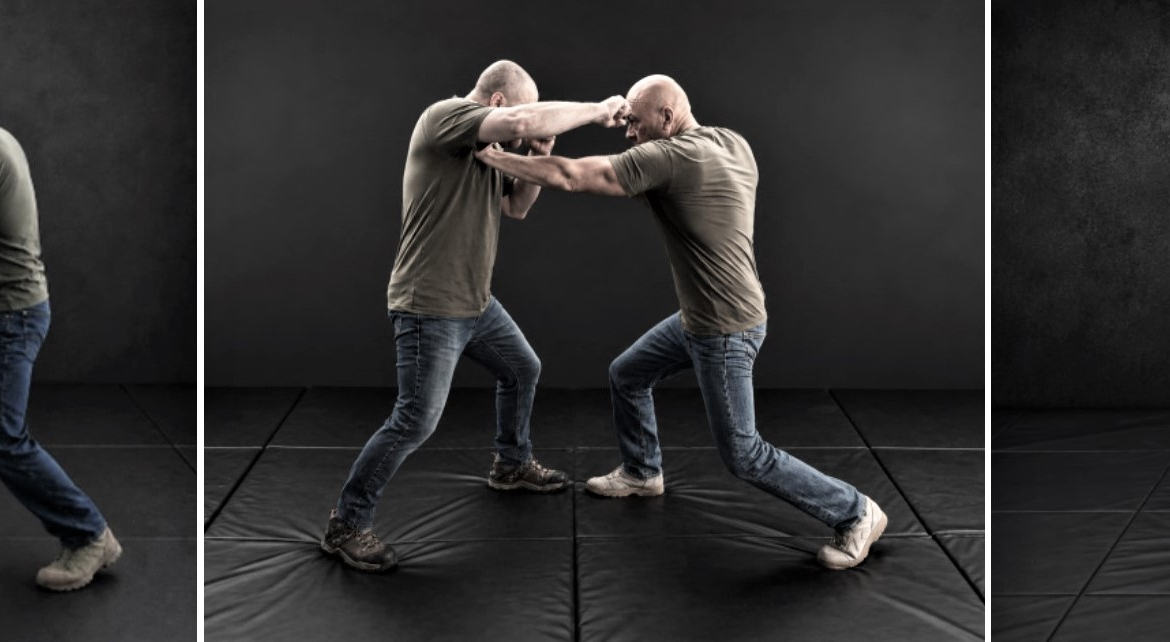
Frames 4 through 6: Then comes the defining leg action
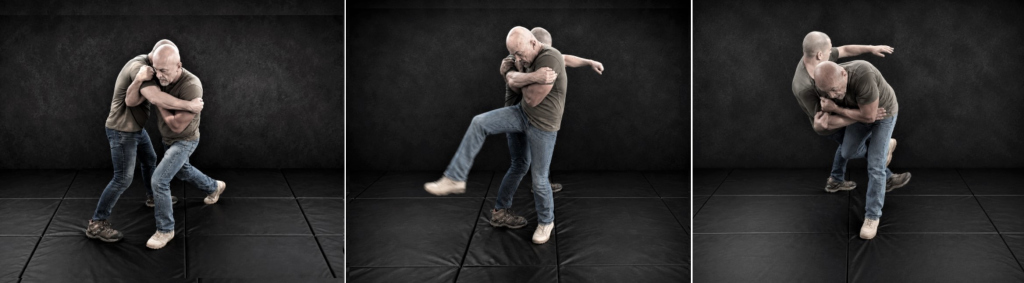
At this point the upper-body mechanics have created the conditions for the lower-body attack. The Cross Hock does not require the practitioner to suddenly abandon this forward-driving sequence and perform a large, sweeping leg action. The knee comes upward and the attacking leg delivers the characteristic compact chopping action against the opponent’s supporting leg.
This is where the distinction from Osoto Gari again becomes important. The Cross Hock’s sequence is not built around entering and then producing a broad major outside reap.
Instead, the upper body has already been subjected to: Impact → Attachment → Traction → Forward Pressure.
The lower-body attack then adds: Chamber → Chop → Displacement.
The Cross Hock is therefore attacking the opponent’s structure from both ends.
Upper structure and lower structure collapse together
The complete biomechanical objective is to create a mismatch between the opponent’s center of mass and his remaining base of support. Above, the opponent is being struck, pulled, redirected, and controlled. Below, the supporting leg is being forcefully displaced. This is why the Cross Hock should not be analyzed merely as a “leg technique.” The leg chop is the culmination of a postural-destruction sequence that began with the initial shoulder strike.
The complete combative Cross Hock can therefore be represented as:
- FALSE LEAD
- FORWARD ENTRY
- SHOULDER IMPACT
- IMMEDIATE GRAB
- JAB-LIKE EXTRACTION
- EXTRACTION BECOMES THE PULL
- OPPONENT IS DRAWN TOWARD YOU WHILE YOU ADVANCE
- DISTANCE RAPIDLY COLLAPSES
- POSTURE CONTINUES TO DETERIORATE
- KNEE CHAMBERS
- LEG CHOPS THROUGH THE SUPPORTING LEG
- STRUCTURAL COLLAPSE
The central mechanical principle is therefore convergence. You are not simply moving yourself into position to execute the Cross Hock. Through the strike-to-grab-to-pull transition, you are simultaneously bringing the opponent into the position where the Cross Hock can occur. That is what makes the sequence so economical from a combatives standpoint: the strike creates the disruption, the recovery of the strike creates the pull, the pull accelerates the entry, and the entry places the supporting leg within range of the chop.
Nothing has to stop before the next action begins.
JOIN THE UNITED STATES COMBAT JUDO FEDERATION TODAY! REAL COMBAT JUDO
For more information on Combat Judo and related subjects.
 THREE COMBAT JUDO EBOOKS — $12.99 EACH
From the battlefields of WWII to modern combative application, explore the history, biomechanics, tactics, and techniques of Combat Judo through three books by Barron Shepherd.
🥋 COMBAT JUDO: HISTORY AND TECHNIQUES
Discover the origins and evolution of U.S. Army wartime Combat Judo.
💥 THE CROSS HOCK TAKEDOWN
A definitive historical, biomechanical, and tactical study of one of the U.S. Army’s classic combat takedowns.
🥊 REAL COMBAT JUDO
No mats. No point scoring. Pure combative application.
💳 TO ORDER VIA PAYPAL:
Send payment to: winterhavenjudo@gmail.com Please include the title of the ebook you are purchasing and email address with your payment.
LEARN. TRAIN. APPLY. WIN.