 Understanding the Architecture of the U.S. Army’s WWII Close-Combat Course
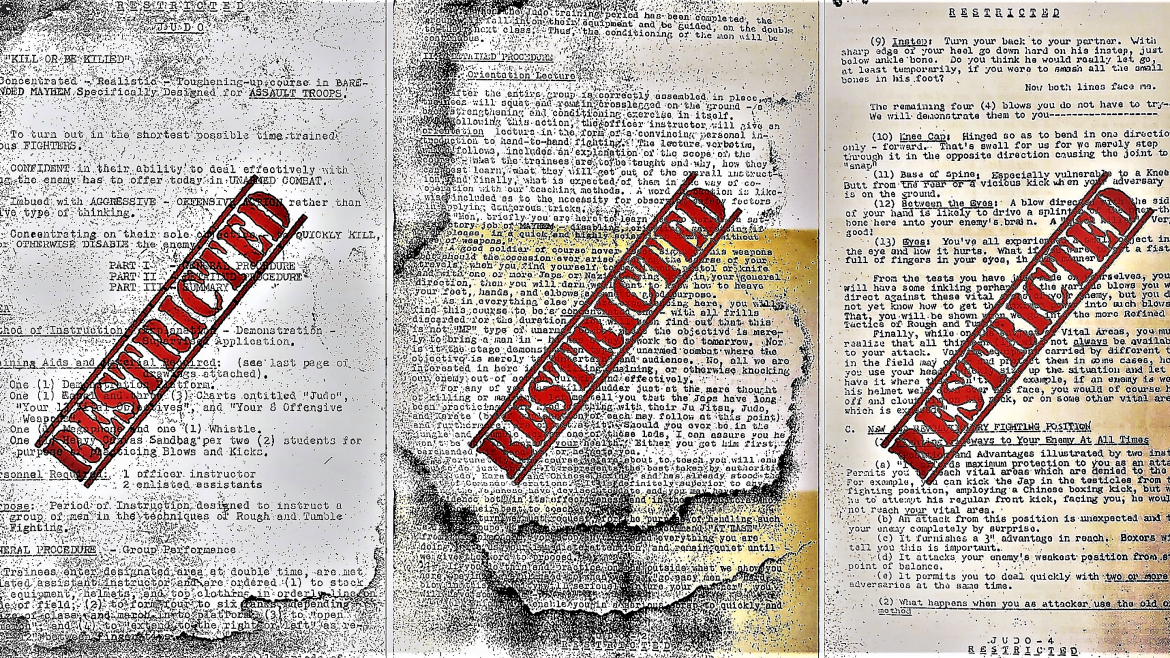
At first glance, the World War II-era Restricted Judo course can look like a collection of harsh hand-to-hand combat techniques assembled for soldiers preparing for war. There are fighting positions, balance drills, kicks, strikes, breakaways, attacks from the rear, and methods intended for circumstances far removed from modern sporting Judo. But read the document from beginning to end rather than simply examining its individual techniques, and something more interesting begins to emerge. The order appears to matter.
Restricted Judo was not simply teaching soldiers what to do. Its organization suggests an attempt to teach them how to fight progressively—beginning with movement, balance, aggression, and gross-motor actions before advancing toward increasingly specialized close-combat problems. That makes the document interesting not only as a collection of WWII fighting techniques, but as an example of wartime instructional design.
First, Build the Fighter
One of the most revealing features of Restricted Judo is that the course does not simply begin with its most dangerous techniques. Instead, the soldier is first introduced to the physical foundation from which everything else develops. The fighting position establishes how the body is organized. Footwork establishes how that structure moves. Balance-oriented exercises teach the soldier how to maintain his own base while interfering with another man’s. This is significant because nearly everything that follows depends upon those abilities.
Before a soldier can effectively strike, break away from an opponent, disrupt posture, or exploit positional advantage, he must first be capable of moving his own body while remaining balanced. The course therefore appears to build from the ground upward.
Position before technique. Movement before application. Balance before disruption.
That is sound instructional logic regardless of the era.
The Rooster Fight: More Important Than It Looks
The Rooster Fight is an especially revealing example. Viewed in isolation, it can appear almost like a rough physical-conditioning game. Two soldiers balance on one leg while holding the other behind themselves, driving their shoulders into one another in an attempt to knock the opponent off balance. But within the progression of the course, the drill makes considerably more sense. It teaches the soldier to experience balance dynamically. He learns what happens when his center of mass moves beyond his support. He experiences external pressure. He discovers how another person’s movement affects his own stability. And, perhaps most importantly, he begins learning that an opponent who has lost his balance becomes easier to control.
There is also a psychological component. The drill encourages contact, pressure, competition, and forward action. The soldier is not merely learning a mechanical concept. He is being conditioned to remain functional while another man is physically attempting to overwhelm him. That becomes important later. The Rooster Fight therefore appears to occupy an important bridge between physical conditioning and fighting psychology.
Then Come the Weapons Already Attached to the Body
Once stance, movement, balance, and aggressive physical engagement have been introduced, the syllabus turns increasingly toward striking. This progression is logical. A soldier does not need to carry his hands, elbows, knees, or boots in a holster. They are immediately available. But Restricted Judo does not appear interested in creating sophisticated competitive strikers. The objective is battlefield utility.
The kicking material is particularly illustrative. Rather than developing an elaborate kicking repertoire, the course concentrates on direct actions appropriate to military footwear and close combat. The same philosophy appears in the elbow material. The elbow is compact. It requires relatively little operating distance. It can be integrated into close-range fighting. Again, the course appears to favor simplicity, accessibility, and gross-motor efficiency over technical variety. This is a recurring characteristic of Restricted Judo. The question is not:
How many techniques can the soldier learn?
The question appears closer to:
How few principles can be taught that will solve the greatest number of battlefield problems?
The Shove Breakaway Introduces a Different Problem
Eventually, the syllabus acknowledges something every fighting system must address:
What happens when the preferred fighting position fails?
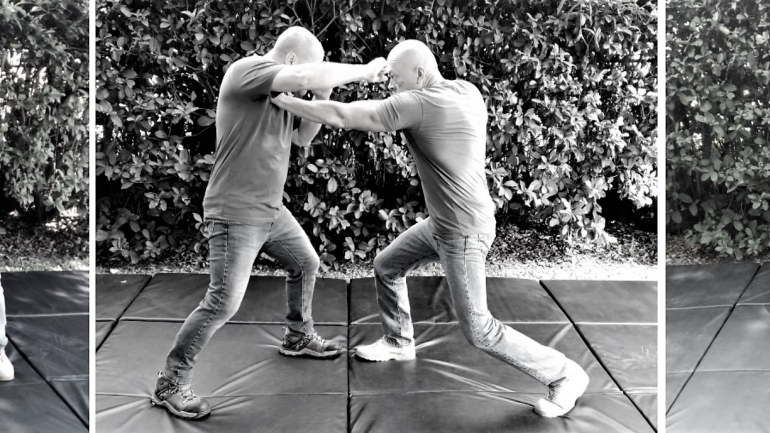
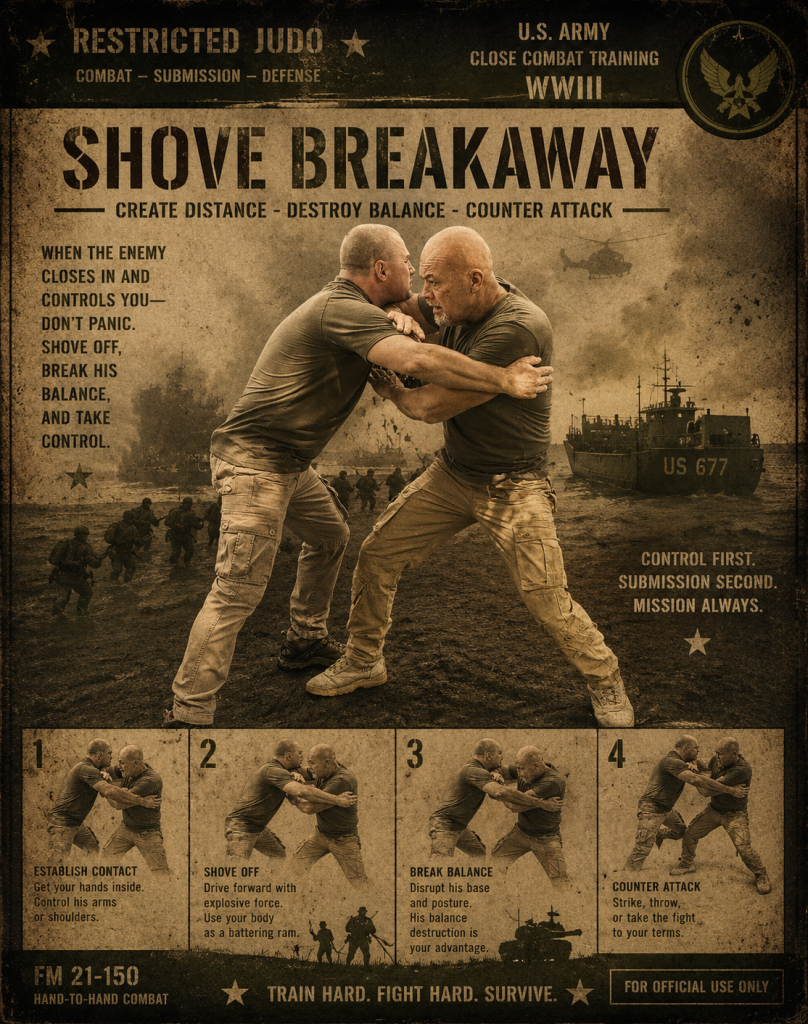
The enemy gets close. The soldier’s arms become partially tied up. The fight collapses into a clinch. The Shove Breakaway is important because it shows that Restricted Judo was not constructed around the assumption that the soldier would always maintain perfect position. Instead, it gives him a recovery mechanism. The soldier establishes structure against the opponent, drives forward, disrupts the opponent’s balance, and creates separation.
The tactical objective is not merely to push someone away. It is to recover fighting distance while leaving the opponent momentarily compromised. That distinction becomes even clearer because the breakaway flows into further offensive action. This reflects a principle running through much of the course: Defense should create offense. The soldier is not taught merely to escape pressure and reset. He is taught to reverse it.
Balance Becomes an Offensive Weapon
This is where the earlier lessons begin coming together. Balance was introduced near the beginning as something the soldier needed to preserve. Later, balance becomes something he deliberately takes away from the enemy. That progression is important. The concept evolves from: protect your own base to: recognize instability to: create instability in someone else to: exploit that instability immediately. This is one reason the word Judo becomes so interesting when examining the course historically.
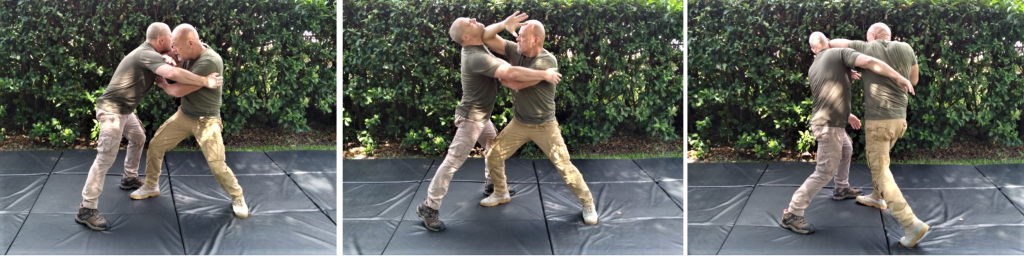
The syllabus certainly isn’t orthodox Kodokan Judo. Its battlefield methods extend far beyond sporting or conventional Judo practice. Nevertheless, principles involving balance, posture, leverage, body positioning, and structural disruption appear repeatedly within it. The course effectively takes those concepts and places them inside a military close-combat framework.
The Techniques Become Progressively More Situational
Another pattern emerges as the syllabus advances. The earlier material develops broadly useful physical attributes and weapons. Later material begins addressing increasingly specific tactical circumstances. The enemy has grabbed you. The enemy has closed distance. You have reached his side. You have gotten behind him. You have surprised a sentry. This represents an important instructional transition. The soldier first learns tools. Then he learns problems those tools can solve. That is very different from simply memorizing a catalog of techniques.
Why Attacks From the Rear Come Later
The rear-attack material represents perhaps the clearest example. Techniques such as the Judo Throttle and Neck Break assume that the soldier has already achieved an extraordinary tactical advantage: the enemy has not successfully faced him. At this stage, the problem is no longer conventional fighting. It is positional exploitation. The soldier must understand proximity, balance, posture, leverage, surprise, and continuous action. Those concepts have already been introduced elsewhere in simpler forms.
Consequently, placing rear attacks later in the curriculum makes instructional sense. The course has progressed from: learning to stand and move to learning to strike to learning to disrupt balance to recovering when an opponent closes to controlling increasingly advantageous positions and finally to exploiting surprise and positional superiority in battlefield-specific situations.
The technical complexity may not always increase dramatically. The tactical context does.
The Course Is Teaching Transitions
This may be one of the most overlooked characteristics of Restricted Judo. The syllabus is not simply about individual techniques. It repeatedly teaches movement between conditions. Longer range becomes close range. A clinch becomes a breakaway. A disruption becomes a strike. A balance break becomes an opportunity. A rear position becomes a decisive control.
This suggests that the real architecture of the course can be expressed as:
POSITION → MOVE → DISRUPT → CONTROL → CONTINUE
Individual techniques are manifestations of that larger process. That helps explain why studying Restricted Judo simply by comparing individual techniques with Judo, Jujutsu, boxing, wrestling, or British commando methods can miss part of the story. The more important question may be: How were the techniques intended to work together as a fighting system?
Why the Order Matters
The syllabus appears to follow a recognizable educational progression:
Foundation: stance, movement and balance.
Physical and psychological preparation: competitive balance exercises and aggressive contact.
Weapons: straightforward striking with the body’s natural weapons.
Disruption: attacking posture and balance.
Recovery: responding when the enemy penetrates the preferred fighting range.
Integration: combining movement, disruption, striking and control.
Tactical specialization: applying those principles to grabs, close-quarter problems and rear attacks.
Battlefield application: using surprise, positional advantage and decisive action against an enemy under wartime conditions.
Seen this way, the course becomes considerably more sophisticated than its relatively simple techniques initially suggest. And that may have been intentional.
Simplicity Was a Feature, Not a Limitation
The soldiers passing through an amphibious training center were not necessarily martial artists. They did not have years to master an elaborate fighting system. The curriculum therefore had to produce usable capability quickly. That meant techniques needed to be relatively simple. But simplicity does not necessarily mean unsophisticated instructional design.
In fact, the opposite may be true. The sophistication of Restricted Judo may lie precisely in the fact that a relatively small number of physical principles are repeatedly recycled to solve different tactical problems. Balance appears again and again. So does posture. So does forward pressure. So does leverage. So does offensive initiative. So does continuation. The soldier does not need to memorize an entirely new theory every time the situation changes. He applies familiar principles to a different problem.
From Technique to System
This is ultimately why I believe Restricted Judo deserves to be studied as something more than an obscure WWII hand-to-hand combat document or looked as simply a collection o techniques.. If we isolate the individual techniques, we see kicks, elbow strikes, breakaways, controls, rear attacks, and other battlefield methods. But if we examine why those lessons appear where they do, another possibility emerges. The document appears to contain an instructional architecture.
The soldier is progressively taught: how to organize his body, how to move it, how to maintain balance, how to disrupt another man’s balance, how to generate force efficiently, how to recover when his preferred position fails, how to transition between ranges, how to exploit positional advantage, and how to maintain offensive initiative once that advantage has been created. Only after those foundations have been established does the syllabus reach some of its most specialized battlefield applications.
That order matters. Because perhaps the real lesson preserved in Restricted Judo isn’t any particular kick, elbow, breakaway, throttle, or neck-breaking method. It is the method by which all those techniques were organized into something a soldier could learn, understand, retain, and apply under pressure. And more than eighty years later, that instructional architecture may be one of the most interesting things the Restricted Judo document still has to teach us.
JOIN THE UNITED STATES COMBAT JUDO FEDERATION TODAY! REAL COMBAT JUDO
For more information on Combat Judo and related subjects.
 THREE COMBAT JUDO EBOOKS — $12.99 EACH
From the battlefields of WWII to modern combative application, explore the history, biomechanics, tactics, and techniques of Combat Judo through three books by Barron Shepherd.
🥋 COMBAT JUDO: HISTORY AND TECHNIQUES
Discover the origins and evolution of U.S. Army wartime Combat Judo.
💥 THE CROSS HOCK TAKEDOWN
A definitive historical, biomechanical, and tactical study of one of the U.S. Army’s classic combat takedowns.
🥊 REAL COMBAT JUDO
No mats. No point scoring. Pure combative application.
💳 TO ORDER VIA PAYPAL:
Send payment to: winterhavenjudo@gmail.com Please include the title of the ebook you are purchasing and email address with your payment.
LEARN. TRAIN. APPLY. WIN.